Logic Puzzles





About Logic Puzzles
A logic puzzle hands you every clue you need and nothing you have to guess. The rules are on the table, the clues are honest, and hidden in them is exactly one answer. The pleasure is the moment a deduction closes: this square must be filled, so that one cannot be, so the piece goes here. Every game on this page is built that way, and every one plays free in your browser, with nothing to install.
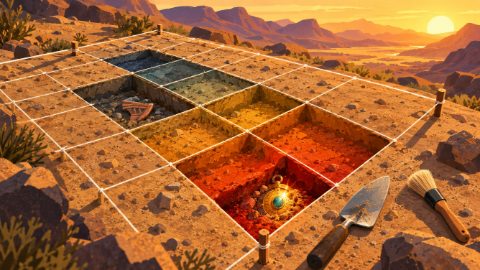
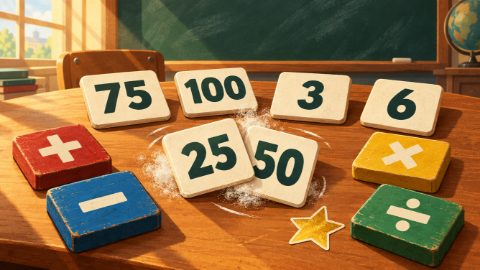
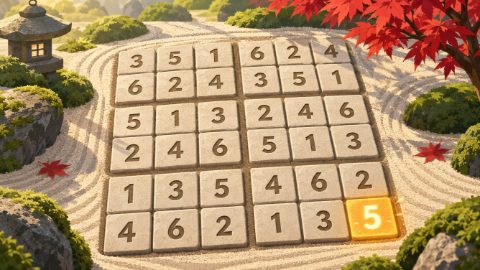
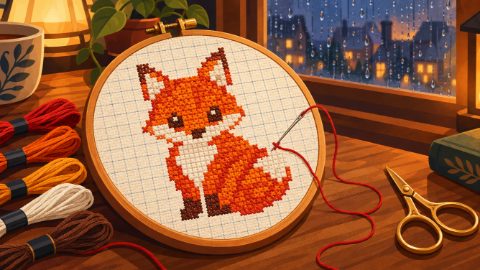
Stitch is a nonogram worked in cross-stitch: the numbers beside each row and column say how many stitches run in a line, and every game deals three new hoops that reveal three motifs. Sudoku Sprint puts 6×6 mini sudokus on a clock that wins time back for every grid you solve. Dig Site buries a find in a 12×12 grid and gives you six digs to reach it, then deals the next site, as many as you can dig before sundown, the same sites for everyone each day: the soil colour says how far away it is, a pottery shard says it lies in line, and two or three trenches together leave a single square. Exactly deals six number cards and a target to hit with + − × ÷, and Mate in One is a run of chess positions from real games where one move ends it.
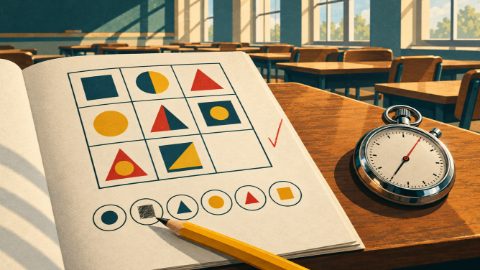
Daily IQ sets ten reasoning puzzles a day, from number sequences and matrices to mirror images and paper folding, and every one is checked by a solver so that exactly one option fits. Fold asks you to fold a square of paper until it covers a dotted shape in as few folds as par. Tip the Scales is weight times distance on a brass balance, with one weighing per puzzle. And Unpark is the classic sliding-block puzzle: shuffle the cars and trucks along their lanes until the red car can drive out of the lot.
Logic puzzles against the clock, and without one
Some of these puzzles race you. Circuit Breaker gives you a panel of switches, splitters and hazards: flip the right switches so the power reaches the bulb and no hazard, then pull the lever before the fuse burns down, panel after panel until three strikes. Sudoku Sprint, Mate in One and Unpark run on a clock too. Others let you think: the daily tests of Daily IQ and Tip the Scales have no clock at all, and Stitch shows a stopwatch that only counts up, so a slow, careful solve still finishes the hoop.
How to get better at logic puzzles
Start from the tightest constraint. In a nonogram, look for the row or column whose counts can only fit one way, such as a 5 in a row of five. In a sudoku, look for the box with one gap. In Dig Site, put two trenches together and only a few squares fit both clues. In Unpark, work backwards from the red car: which vehicle blocks it, and what blocks that one? Never guess when a deduction is available: these puzzles are built to be solved by reasoning, not luck. And play the daily ones every day: the patterns repeat, and recognising them is most of the skill.
Frequently asked questions
What is a logic puzzle?
A puzzle you solve by reasoning from the clues alone. There is one correct answer, and luck and general knowledge play no part. Sudoku, nonograms, sliding-block puzzles and chess problems are all logic puzzles.
Which of these logic puzzles are daily?
Dig Site, Exactly, Daily IQ, Fold and Tip the Scales deal the same puzzles to everyone each day, with a new set at midnight ET. Stitch, Sudoku Sprint, Mate in One, Unpark and Circuit Breaker deal new puzzles every time you play.
Are there logic puzzles with no time limit?
Yes. The daily test of Daily IQ and the daily five of Tip the Scales have no clock, and Stitch only counts up, so you can take your time, although in Daily IQ a quicker right answer is worth more.
Do I need to be good at maths?
Mostly not. Exactly is arithmetic and Tip the Scales asks for one multiplication per side, but Stitch, Sudoku Sprint, Dig Site, Fold, Unpark and Circuit Breaker only use numbers as counts or symbols. Mate in One needs you to know how the chess pieces move.
Are the logic puzzles free?
Yes. Every game on Gamefinity is free to play in your browser with no download and no sign-up.