Older Than You Think
Which came first? Sixteen pairs, from obvious to "wait, really?"
- Round
- 2 minutes
- Works on
- Mobile & desktop
- Category
- Quiz
Older Than You Think controls: Tap the one that came first · ↑ ↓ keys work too. Press Play, then the game takes the keyboard. Press Tab to leave it.
Free play · 2 minutes · no sign-in
Tap the one that came first · ↑ ↓ keys work too
How to play Older Than You Think
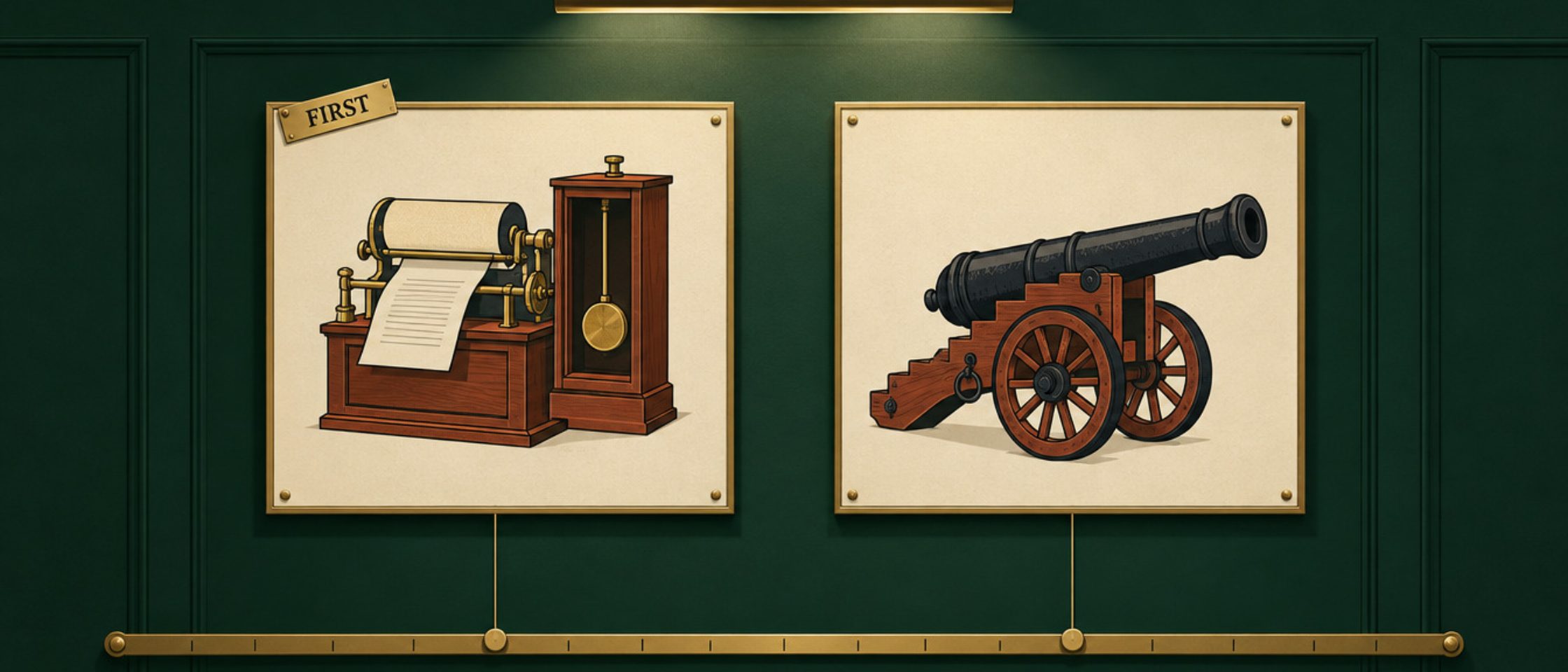
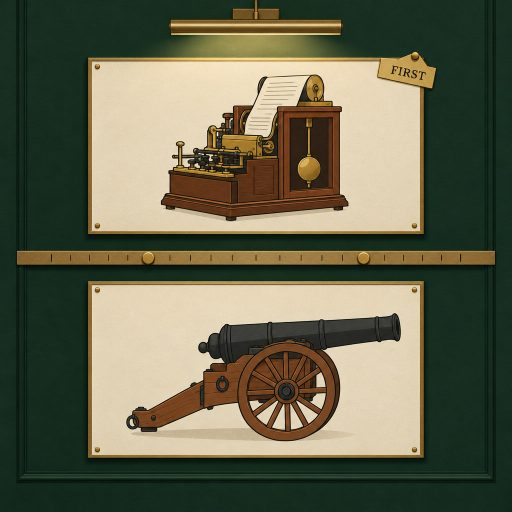
Read the two museum labels: each names a thing and what its date means, such as founded, patented or born.
Tap the one that came first before the brass fuse between them burns down.
Watch the reveal: both dates drop onto the timeline and a fact explains the surprise.
Tap to move on to the next pair; a visit is sixteen pairs.
Keep a streak going for up to triple points: one miss ends it.
Controls
| Input | Action |
|---|---|
| Touch: tap a label | Choose it as the one that came first |
| Touch: tap anywhere during a reveal | Move on to the next pair |
| Mouse: click a label | Choose it; click anywhere during a reveal to move on |
| ↑, W or 1 | Choose the upper label |
| ↓, S or 2 | Choose the lower label |
| Space or Enter | Move on after a reveal or from the end card |
Tips
Read the small line on each label: founded, patented and first published can be decades away from when a thing became famous.
Companies are often far older than their famous products; many started in the 1800s making something else entirely.
Countries can be surprisingly young: Norway, Finland and Iceland as independent states are all younger than the light bulb.
Old universities and companies are often older than the empires and monuments they feel younger than.
Answer the obvious pairs quickly to bank the speed bonus, and spend your seconds on the trap rooms at the end.
About Older Than You Think
Older Than You Think is a free which came first game you play in your browser. Two museum labels hang on a gallery wall, say the fax machine and the American Civil War, or Oxford University and Tenochtitlan, the Aztec capital, and you tap the one that is older. Then comes the reveal: both dates drop onto a brass timeline, the older label gets its FIRST tab, and a short "wait, really?" fact tells you why. It is a history trivia game about the things you thought you knew: inventions, companies, buildings, books, films, songs, famous people and events, from the Great Pyramid to Wordle.
A run is sixteen pairs that ramp from obvious to counterintuitive. The first rooms of the museum are warm-ups, then the pairs get closer, and the last rooms hold the ones almost everybody gets wrong: Nokia is older than the telephone, Abraham Lincoln was born before Belgium existed, and the Caesar salad is younger than Paramount Pictures. Every visit plays all sixteen pairs, so everyone gets to the surprises; a wrong pick, or letting the 5.5-second fuse between the labels burn down, ends your streak. The visit card at the end shows how many you got right, your best streak, your average answer time and the pair you fell for.
Every date comes from Wikidata, and each label shows its source and what its date means: founded, patented, first published, born. The pool holds more than 500 items in 600 pairs, every date was cross-checked against Wikipedia, and anything whose date is disputed or depends on a convention was left out, so each pair has one honest answer. Where a date is approximate, as with the Great Pyramid, the label says "c." and the pair is only used when the gap is far bigger than the uncertainty. Pairs whose order follows from a link, like a person and their own invention, are never asked.
Scoring rewards knowledge and nerve. A right answer earns 100 to 200 points depending on how tricky the pair is, plus up to 50 for answering quickly, multiplied by your streak: ×1.25 for the second right answer in a row, rising to ×3 from the ninth, so one miss late in a run costs more than it seems and lucky guesses rarely add up. Misses never take points away. Play casually as often as you like, or take a ranked attempt for the leaderboards of our competitive games; ranked runs are verified by replaying them on our servers. On Gamefinity everyone's casual run of the day deals the same sixteen pairs, so after each reveal you also see how many of today's players got it right.
It plays the same on any screen: tap a label on a phone or tablet, click it with a mouse, or press the up and down arrows (or 1 and 2) on a keyboard, with Space to move on after a reveal. A full visit takes about a minute and a half, which makes it one of our quick games and a natural fit with our other quiz games. It is also one of our casual games for adults, and you will find more to play among our mobile games and PC games.
Details
- Category
- Quiz & Trivia Games
- Tags
- Genre
- Trivia
- Orientation
- Portrait (9:16)
- Works on
- Mobile & desktopPhones, tablets and computers
- Controls
- Keyboard, mouse or touch
- Released
- Updated
- Credits
- Design and development: Gamefinity
- Dates: Wikidata (CC0)
- Age rating
- 4+
Older Than You Think FAQ
How long does a game of Older Than You Think take?
A visit of sixteen pairs takes about 90 seconds. You have 5.5 seconds to choose each pair, and every visit plays all sixteen, however many you miss.
Where do the dates come from?
Every date comes from Wikidata, the open database behind Wikipedia, and each label shows the Wikidata item it came from. The dates were cross-checked against Wikipedia, and items with disputed dates were left out.
Why does a label say founded or patented?
Many things have more than one date. The small line on each label says which one counts, such as when a company was founded or an invention was first patented, so each pair has exactly one right answer.
How is the score calculated?
A right answer earns 100 to 200 points by difficulty plus up to 50 for speed, multiplied by your streak (×1.25 for two right in a row, up to ×3 from nine in a row). A miss ends the streak but never takes points away; a perfect, fast visit scores about 7,900.
Is it the same pairs every day?
On Gamefinity, casual runs deal the same sixteen pairs to everyone on a given day, so you can compare with friends and see how today's players did. Ranked runs deal pairs of their own.
Can I play Older Than You Think on my phone?
Yes. It works on phones, tablets and computers: tap a label on a touch screen, click it with a mouse, or use the arrow keys.
Next up
More games like Older Than You Think.