Daily IQ
Ten puzzles a day, no clock. Answer fast for a higher score.
- Length
- Untimed
- Quick run
- 2-minute version in Swipe mode
- Works on
- Mobile & desktop
- Category
- Puzzle

Daily IQ controls: Tap an answer · keys 1-6 or A-F work too. Press Play, then the game takes the keyboard. Press Tab to leave it.
Today's Daily IQ · one try a day
Tap an answer · keys 1-6 or A-F work too
How to play Daily IQ
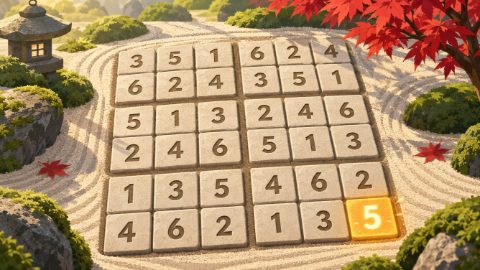
Read the question on the booklet's page: what comes next, which tile completes the grid, which one doesn't belong.
Tap the answer on the answer sheet below (or press 1–6 or A–F). There is no time limit, but the longer you take, the fewer points a correct answer is worth.
Answer carefully (one try a question) and move quickly when you are sure: the points for a question drain the whole time it is open.
After ten questions the sheet is graded: see your IQ-style score against today's players and how everyone did on each question.
Tap any question to see its answer and the rule behind it, then share your result and come back tomorrow for a new test. Pick Timed mode for the stopwatch version Swipe mode and the leaderboards use.
Controls
| Input | Action |
|---|---|
| Touch: tap an answer card | Answer the question (it is marked at once) |
| Touch: tap a graded question | See its answer and the rule; tap again to close |
| Mouse: click | The same as a tap: answers, graded questions and HAND IN |
| Keys 1–6 or A–F | Answer with the first to sixth option |
| Keys 1–9 and 0 (graded sheet) | Open questions 1–10; Backspace closes |
| Enter or Space (graded sheet) | Hand the booklet in |
Tips
In a number series, write down the gaps between the numbers. If the gaps don't repeat, look at the gaps between the gaps, or at two series taking turns.
In a grid, check one thing at a time along each row: the shape, then the shading, then how many, then where the dot sits. Each can follow its own rule.
For odd one out, find what four of them share: a shape, a fill, a count, a multiple, a digit sum. The one left over is your answer.
For rotation and mirror questions, pick one corner of the shape and follow it: a turned shape keeps its corners in the same order, a mirror image reverses them.
For paper folding, undo the folds last first: every hole is copied across each crease, so one punch through two folds makes four holes.
There is no deadline, but the points drain the whole time a question is open, so answer the warm-ups the moment you are sure of them: that is where the easiest points are.
On the hard questions near the end, a few extra seconds of real thought is worth more than a fast guess: a wrong answer scores nothing, however quick.
Modes
- Daily testToday's ten puzzles, no clock: answer fast for a higher score
- PracticeTen fresh puzzles every time, no clock, as often as you likeCasual only
- TimedToday's ten puzzles against a stopwatch, for Swipe and the leaderboards
More from Daily IQ
About Daily IQ
Daily IQ is a free daily IQ test of IQ-style puzzles, played for fun in your browser: ten reasoning puzzles a day, the same ten for everyone, in about a minute and a half. There is no clock on a question: take as long as you like. But answer fast and you score far more, so a confident, quick answer is always worth more than a slow one. It looks like a 1960s aptitude-test booklet, with an answer sheet you fill in with a pencil and a red-ink stamp at the end, and it covers the classic kinds of IQ puzzles: number sequences and letter series, Raven-style matrix puzzles where you pick the missing tile, odd one out with numbers and shapes, mental rotation and mirror images, shape analogies (A is to B as C is to …?) and paper folding. It is one of our daily puzzle games like Wordle and brain games: one test a day, and a reason to come back tomorrow.
The test ramps up as you go. The first questions are warm-ups almost everyone gets right, the middle ones ask you to spot two rules at once, and the last two are genuinely hard: three rules hiding in a 3×3 grid, lines that cancel out when two tiles overlap, a sheet folded twice before the punch. Each correct answer is worth up to 1,000 points that drain the longer you sit on it, so the booklet shows the proctor's stopwatch running and the answer's current value falling toward the floor as you think: speed clearly pays, but there is never a deadline. You see at once whether you were right, with the correct answer circled in red when you were not.
Every puzzle is generated and then proven: no trivia, no trick wording and no question that depends on what you happen to know. Before a question reaches you, a solver checks it against a whole library of simple rules (constant steps, doubling, two series taking turns, rows that add up, shapes that turn or mirror) and keeps it only when exactly one answer fits any rule and every other option is provably wrong. No puzzle of the Daily test comes back within a year, and a fresh test opens every day at midnight ET.
At the end the answer sheet is graded and stamped with your IQ-style score: where your result sits among today's players of the Daily test, on the 100 ± 15 scale IQ tests use, together with lines like "Sharper than 72% of today's players" and how everyone did on each question, so you can see that only 18% got the overlay grid. It is a game, for fun, not a clinical or validated IQ test, and the page says so. Your share line is your score, your marks out of ten and a row of squares, ready for a group chat. Tap any question afterwards to see its answer and the rule behind it.
Daily IQ has two ways to play, both with ten puzzles: the Daily test (the default, untimed and scored by speed, the same for everyone that day, one go a day) and Timed (the original stopwatch test, one clock a question, fresh puzzles as often as you like with leaderboards of its own, the version Swipe mode and gauntlets play). Daily IQ plays the same on a phone and a computer in every mode: tap or click an answer, or use the keys 1–6 or A–F. Your marks and speed go on the leaderboards of our competitive games, where top scores are verified by replaying the run. Find more puzzle games, logic puzzles, number games and quick games, see today's other daily games, or browse our mobile games, PC games, casual games for adults and free games to play at work.
Details
- Category
- Puzzle Games
- Tags
- Genre
- Puzzle
- Orientation
- Portrait (9:16)
- Works on
- Mobile & desktopPhones, tablets and computers
- Controls
- Keyboard, mouse or touch
- Length
- Today's ten puzzles, no clock: answer fast for a higher score (2-minute version in Swipe mode)
- Modes
- 3
- Released
- Updated
- Credits
- Design and development: Gamefinity
- Age rating
- 4+
Daily IQ FAQ
Is Daily IQ a real IQ test?
No. It is a game made of IQ-style puzzles, for fun. The score shows where your result sits among today's players on the 100 ± 15 scale IQ tests use, but the test is not clinical, validated or standardised, as this page says.
How is the IQ-style score worked out?
On the Daily test, your result (correct answers first, then speed) is ranked among everyone who took today's test, and that percentile is placed on the normal curve with a mean of 100 and a spread of 15. Early in the day, before many people have played, it is blended with a model calibrated on thousands of simulated test-takers, so the number is steady from the first player on. A Timed score is placed against that model alone.
Is there a time limit?
Not in the default Daily test: there is no clock on a question, so you can take as long as you need. A correct answer is worth up to 1,000 points that drain the longer you sit on it, so answering quickly and confidently still scores the most. If you want the original stopwatch test instead, one clock a question, choose Timed mode: it is also the version Swipe mode and gauntlets play.
Is it the same test for everyone?
Yes. The Daily test deals the same ten puzzles to everyone on the same day, which is how it can compare you with today's players and show how many got each question. A new test opens every day at midnight ET, and past days stay playable from the archive.
Do the puzzles ever repeat?
Not on the Daily test within a year. Every puzzle is generated by the game, and the daily tests are dealt so that no puzzle comes back within 365 days, in any place in the test. A number series with its gap moved, or a shape that is only turned or flipped, counts as the same puzzle. Timed mode deals a fresh random test every time, so now and then one of its puzzles can match one you have seen before.
How long does it take?
About a minute and a half on average, even with no clock, since most people answer well before the points bottom out. Timed mode caps the whole test at two minutes, with 7 to 15 seconds for each question and any time you don't use carried over to the next one.
Can every puzzle really have only one answer?
Yes. Every puzzle is generated by the game and checked by a solver before you see it: the solver tries a whole library of simple rules on every option, and the puzzle is kept only when exactly one option fits any of them.
Can I play Daily IQ on my phone?
Yes. It is made for a phone held upright: tap the answers on the answer sheet. On a computer the booklet's page fills the screen beside the answer sheet, and you can click or use the keys 1–6 or A–F.
Can I practise without spoiling today's test?
Yes, in Timed mode: every run deals ten fresh puzzles, as often as you like, with a clock on each question and leaderboards of its own. The Daily test itself is one go a day.
Next up
More games like Daily IQ.