Physics Games


About Physics Games
Physics games are fun because the world behaves the way you expect it to. Throw something and it flies in an arc, stack it badly and it topples, pour too long and it spills. The skill is in understanding those forces well enough to use them. Gamefinity's physics games keep the controls minimal, often a single drag or tap, so all of your attention goes on predicting what the world will do next. Every one is free in your browser and takes a minute or two.
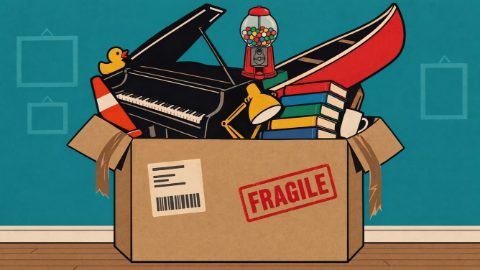
One Stroke lets you draw a single line for a marble to roll home on, ten new sheets a day, and the less ink you use, the more you score. Teeterly is a hanging mobile where weight times distance has to match on both sides of each wire arm, and an arm only swings when you press HANG IT. Pack It hands you everything from a teapot to a grand piano and five tight moving boxes a day, and each pile has to settle under real physics without toppling over the rim. And Orbit Hop launches a little rocket from planet to planet: time each launch so the next planet's gravity catches it. Ball physics drives the mini golf of Clifftop Putt too: putts bank off rails and kick bumpers, and the ball only drops if it reaches the cup slowly enough.
Types of physics games
Drawing puzzles such as One Stroke turn your line into a solid ramp the moment you lift your finger. Balance and stacking games test weight: Teeterly asks for a level arm, and Pack It asks you to fit books, a lamp, a grand piano and a canoe into a moving box without the pile toppling over the rim. Gravity games such as Orbit Hop use orbits and slingshots, and the space games page has more.
Real physics, fair results
Every physics game here runs a deterministic simulation: the same inputs always give exactly the same result, on every phone and every computer. That is what lets us verify leaderboard runs by replaying them on our servers, and it means something simpler for you: every outcome is fair, and every miss was a decision you can improve next time. Teeterly and Pack It are daily games too, with the same mobiles and boxes for everyone each day and a look at how everyone else did once you finish.
Tips from the physics desk
Do the sum before you act. In Teeterly, add up weight times hook on each side: a 3 lb teapot on hook 4 is 12, exactly a 4 lb pineapple on hook 3. In One Stroke, the marble leaves your line in the direction it points, so aim the last few millimeters at the cup. In Pack It, lay long things flat at the bottom and let go close to the pile. And in Orbit Hop, use your first few hops, when a glowing arc marks the launch window, to learn the rhythm of a perfect launch.
How to choose
If you like to plan, choose the games you set up and then watch: Teeterly gives you a minute a tier before you let each arm go, and One Stroke has no clock at all, only three lines a sheet. If you prefer feel, choose Orbit Hop, where the timing of each launch is everything. Pack It sits in between, a quick puzzle of shapes that also asks for a gentle touch. Every one plays by touch or mouse, most also by keyboard, and you can be playing within seconds.
Frequently asked questions
What are physics games?
Games built around a simulation of real-world forces such as gravity, momentum, balance and liquid. You win by predicting how things will move.
Are the physics games free to play?
Yes. Every game on Gamefinity is free, runs in your browser and needs no download or account.
Which physics game should I try first?
One Stroke if you like drawing, Teeterly if you like a neat sum, Pack It if you like a puzzle of shapes and Orbit Hop if you like timing. Each is quick to learn and plays in a few minutes.
Why does the same move always give the same result?
The simulations are deterministic: the same inputs produce exactly the same motion on every device. It keeps the leaderboards fair, because every top run can be replayed and checked.