Loomlarge
LeaderboardWhich is bigger? Call it, then watch both land on one tape at true size.

How to play Loomlarge
Read the question at the top: which is taller, longer, wider or bigger.
Look at the two things and the small line under each name, which says what is measured.
Tap the one you think is bigger before the 10-second tape runs back into its case.
Watch both land on the tape at true size, and read the two measurements.
Tap to go on. Call all ten of today's pairs: faster calls and longer streaks score more.
Come back tomorrow: you get one try a day, and ten new pairs arrive at midnight New York time.
Controls
| Input | Action |
|---|---|
| Touch: tap a card | Call that thing the bigger one |
| Touch: tap anywhere after the reveal | Go on to the next round |
| Mouse: click a card | Call that thing the bigger one; click anywhere to go on |
| ← or ↑ (A or W) | Call the first thing (left, or top) |
| → or ↓ (D or S) | Call the second thing (right, or bottom) |
| Space or Enter | Go on after a reveal |
Tips
Read the small line under each name: a statue with its pedestal, a ship with its bowsprit or a mountain above sea level can be a very different size from the picture in your head.
The first few rounds are meant to be easy, so call them fast: an early streak adds 25 to every right call after it.
Protect a long streak over chasing the speed bonus. Two more seconds of thought cost a few points; a wrong call resets the streak.
Use a yardstick you know: a person is under 2 m, a bus about 11 m, the Statue of Liberty 93 m with its pedestal, the Eiffel Tower 330 m.
When a height meets a length, picture the tall thing lying down: that is exactly what the tape will show.
Animals only appear when the gap is wide, so if a whale or a giraffe is in a round, trust your first instinct.
About Loomlarge
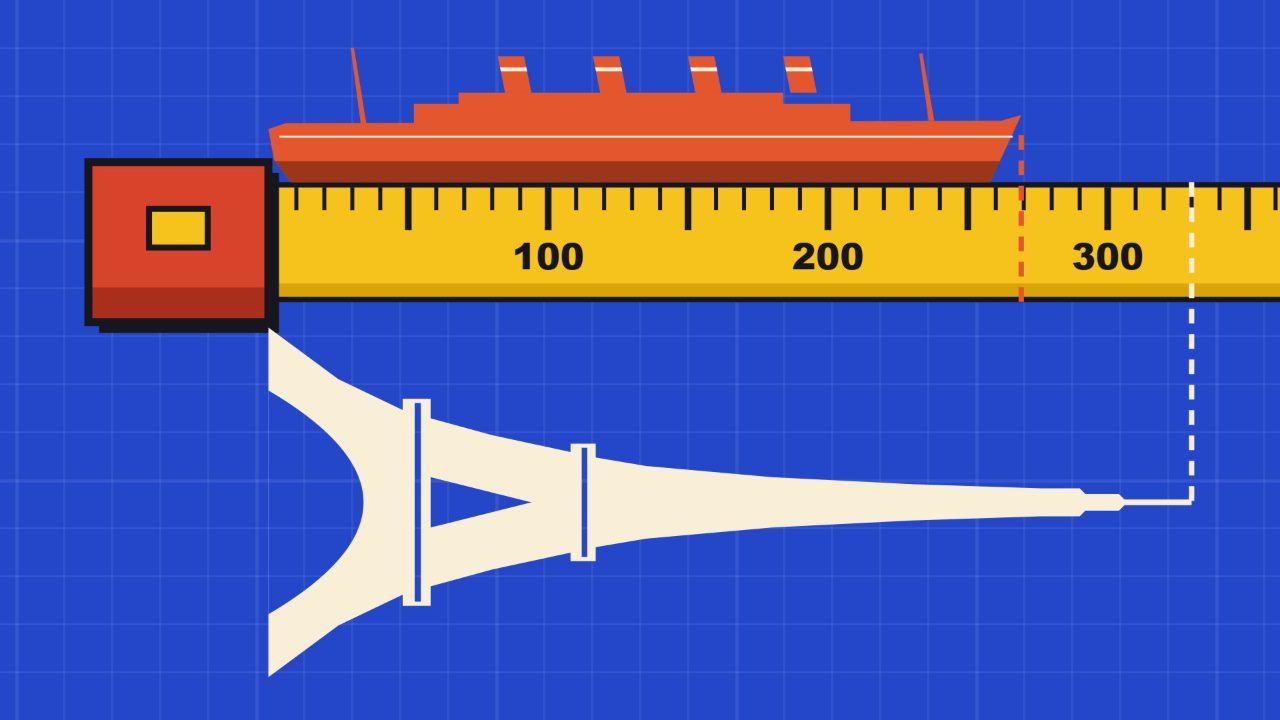
Loomlarge is a free daily higher or lower game with real sizes, a which is bigger game you play in your browser. Each round shows two real things, such as a Tyrannosaurus and a London bus, the Titanic and the Eiffel Tower, or Pluto and one of the Great Lakes, and asks one question: which is taller, longer, wider or simply bigger? Pick one. Then comes the part the game is built around: a steel tape runs out of its case, both things land on it at their true size, and the view pulls back until the bigger one fits. It is a size comparison you can see, not just a number you are told.
A day is ten rounds, one try, and everyone gets the same ten until midnight New York time, when a new set arrives. The first calls are obvious, like an ocean liner against a suspension bridge. Then the two sizes close in, round by round, until the last one is a photo finish with only a few per cent between them: there the two things slide nose to nose and the view pushes in until you can see the gap. Most rounds compare like with like, two heights or two lengths. A few set a height against a length, and say so: the tall thing is laid on its side along the same tape. Every card says exactly what its number measures, such as to the tip of the spire, nose to tail or wingtip to wingtip. Mountains are measured above sea level, so a mountain only ever meets another mountain.
If you like a higher or lower game (some call it more or less), the scoring will feel familiar, with one difference: a wrong call never ends your day. A right call earns 100 points, up to 50 more for calling it quickly, and 25 more for every call you already had right in a row, so a streak is worth far more than the same calls scattered. A wrong call or a round that runs out its 10 seconds earns nothing and breaks the streak, but you still play, and see, all ten. A perfect, fast day is 2,625. When two players finish level, the one who spent less time deciding ranks higher, and after each round you see what share of the day's players got it right.
Every size is a real, checked measurement of one of hundreds of things: buildings, bridges, rockets, ships, aircraft, mountains, lakes, islands, moons, coins and animals. Each has a published figure from an open source and was checked against a second published source. Animals vary, so they are listed as a typical adult or a named record, and the game never puts an animal in a close call where a big or small one could change the answer. The things are drawn as flat silhouettes at their real proportions, so a suspension bridge really is that long and thin, the tape carries both metres and feet, and a person is drawn beside it whenever the scale suits one.
It plays the same on any screen. On a phone or tablet, tap the bigger thing. With a mouse, click it. On a keyboard, the arrow keys pick a side and Space moves on. A full day takes about a minute and a half, which makes it one of our quick games and a good fit beside the other daily games and quiz games. If you enjoy guessing sizes, you may also like our list of games like Size It Up, and there is more to play among our mobile games and PC games.
Details
- Category
- Quiz & Trivia Games
- Tags
- Genre
- Trivia
- Orientation
- Portrait (9:16)
- Works on
- Mobile & desktopPhones, tablets and computers
- Controls
- Keyboard, mouse or touch
- Length
- About 2 min per run
- Plays
- 388
- Released
- Updated
- Credits
- Design and development: Gamefinity
- Animal silhouettes: PhyloPic contributors (CC0 and public domain)
- Lake and island outlines: Natural Earth (public domain)
- Sizes: Wikidata (CC0), NASA, NOAA, USGS and the sources listed with the game
- Age rating
- 4+
Loomlarge FAQ
When does a new Loomlarge arrive, and how many tries do I get?
A new set of ten pairs arrives every midnight New York time, and you get one try at it. Everyone plays the same ten that day, so you can compare scores with friends.
How long does a game of Loomlarge last?
About a minute and a half. A day is ten rounds, each with up to 10 seconds to call and a short reveal of both things at true size. Every day plays all ten rounds, however many you miss.
How is the score calculated?
A right call earns 100 points, plus up to 50 for speed and 25 for every call already right in a row. A wrong call or a timeout earns nothing and resets the streak. A perfect, fast day is 2,625, and ties go to the player who spent less time deciding.
Is Loomlarge a higher or lower game?
Yes, played with sizes: each round is one call between two real things, which is bigger, and the reveal shows both measurements on one tape. Unlike most higher or lower games, a wrong call never ends your day: you play all ten pairs, and a miss costs only that round's points and your streak.
Where do the sizes come from?
From published measurements in open sources such as Wikidata, NASA and NOAA, each checked against a second published source. The card says exactly what is measured, and things that vary, like animals, are never used in a close call.
How can a height be compared with a length?
A few rounds set something tall against something long and ask which is bigger. The cards say which is a height and which a length, and the reveal lays the tall thing on its side along the same tape, so the comparison is exact.
Can I play Loomlarge on my phone?
Yes. It works on phones, tablets and computers: tap a card on a touch screen, click it with a mouse, or use the arrow keys and Space.
Next up
More games like Loomlarge.


