How Many
Guess how many. Then see how close everyone together was.
- Round
- 2 minutes
- Works on
- Mobile & desktop
- Category
- Casual

How Many controls: Tap the keypad or type a number · Enter guesses. Press Play, then the game takes the keyboard. Press Tab to leave it.
Free play · 2 minutes · no sign-in
Tap the keypad or type a number · Enter guesses
How to play How Many
Read the card on the curtain: it names the exhibit and asks how many there are.
When the curtain opens, look hard for a few seconds while the bulbs around the frame go out. There is no time to count, so estimate.
Type your guess on the ticket with the keypad or the number keys. You can start while the exhibit is still showing, and you have nine more seconds after the curtain falls.
Press GUESS (or Enter). The judges count every item, the stamp shows the truth, and the chalkboard shows how everyone else guessed today.
Tap to move on to the next exhibit. After five, read your prize list and share it.
Controls
| Input | Action |
|---|---|
| Touch: tap the keypad | Type your guess; ⌫ removes the last digit |
| Touch: tap GUESS | Hand in your ticket |
| Touch: tap during a reveal | Continue to the next exhibit |
| Mouse: click the keypad | Type your guess and hand it in |
| Keyboard: 0–9 (top row or numpad) | Type your guess |
| Keyboard: BackspaceDelete | Remove the last digit / clear the ticket |
| Keyboard: Enter or Space | Hand in your guess, then continue |
Tips
Count a small patch, then multiply. Pick a square that holds about ten items, count it, and judge how many such squares cover the whole exhibit.
Mind the perspective: sheep and pumpkins far away are smaller and packed tighter, so the top of the scene holds more than it looks.
Clusters fool the eye. Flocks, bunches and the middle of a heap are dense, the edges are sparse; estimate the dense part and the sparse part separately.
Packed jars and gumball globes are rows and columns in disguise: count the beans across and down and multiply, then knock off a little for the curved edges.
The scoring is about ratios, so on the huge exhibits getting the order of magnitude right matters most. Two thousand or five thousand is a bigger question than 3,100 or 3,200.
Most people underestimate large crowds. If your gut says 2,000 on the last exhibit, it is worth nudging up.
About How Many
How Many is a free online guess how many game set at a county-fair guessing booth. The curtain opens on a jar of jelly beans, a gumball machine, a field of sheep, a murmuration of starlings or a packed grandstand for a few seconds, then it falls. There is no time to count, so you estimate: type your number on the admission ticket and hand it in. Then the judges count every single one, a red stamp lands with the true number, and you find out how close you came. It runs in your browser with no download and a game takes about a minute, which makes it one of our favourite quick games and number games.
Every day brings five exhibits, and they climb. The first is friendly, about thirty rubber ducks in a hook-a-duck pool or a bunch of balloons, big enough that a careful look gets you close. Then come a hundred gumballs or pumpkins, then hundreds of jelly beans in a jar, sheep in flocks across the hills or a heap of coins, then a thousand or more, and finally two to five thousand starlings, stars over a farmhouse or people in the stands. The items cluster, overlap and shrink into the distance, so reading the density is the real skill, but every item is always at least partly visible: the count is exact because the game placed every one of them.
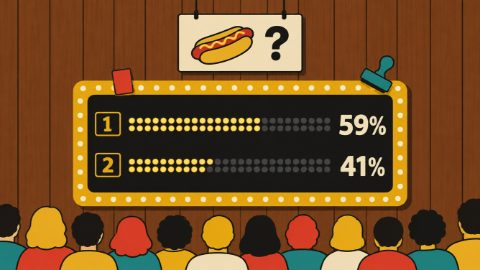
The twist is the wisdom of the crowd. Played for fun, How Many gives everyone the same five exhibits each day, so after every guess the chalkboard shows what everyone else guessed today: a histogram of all the guesses from a quarter of the truth to four times it, the true count, your ticket, and the crowd's median guess. It is often eerily close: "The crowd's median: 1,032. The truth: 1,047. Off by 1.4%." You see how many of today's guessers you were closer than, and whether you beat the crowd's median. The prize list at the end lays out your five guesses against the truth and the crowd, the ribbons you won and how many times you beat the crowd, ready for a screenshot or the share button.
Scoring is fair whichever way you miss. A guess earns up to 1,000 points by its ratio to the truth, so guessing twice too many is exactly as bad as guessing half: 5% off is worth 833 points, 25% off 500 and twice off 200, and even a wild guess earns a little. A blue ribbon goes to guesses within 5%, red within 15%, white within 30%. Five exhibits make a run of up to 5,000 points, and ranked runs are re-simulated on our servers, which puts How Many among our competitive games; the crowd comparison is just for fun and never changes a score.
It plays the same everywhere. On a phone, tap the big booth keypad; on a computer, type with the number keys (the numpad works too), press Backspace to fix a digit and Enter to hand in your guess. Estimation is a real number sense skill, so you will also find How Many among our brain games, casual games, casual games for adults, mobile games and PC games. Come back tomorrow for five new exhibits.
Details
- Category
- Casual Games
- Tags
- Genre
- Casual
- Orientation
- Portrait (9:16)
- Works on
- Mobile & desktopPhones, tablets and computers
- Controls
- Keyboard, mouse or touch
- Released
- Updated
- Credits
- Design and development: Gamefinity
- Age rating
- 4+
How Many FAQ
How long does a game of How Many take?
About a minute. Each of the five exhibits is shown for four to five seconds, you have up to nine more seconds to type your guess, and each reveal takes a few seconds (tap to skip ahead).
How is the score calculated?
Each guess scores up to 1,000 points by how far it is from the truth as a ratio: an exact guess is 1,000, 5% off is 833, 25% off is 500 and twice too many or half too few are both 200. A guess always earns something unless it is more than 250 times off. Five exhibits add up to at most 5,000 points.
What is the crowd's median, and why is it so close?
It is the middle guess of everyone who played the same exhibit today: half guessed more, half guessed less. Individual guesses are often far off in both directions, but the errors tend to cancel out, so the median lands surprisingly close to the truth. This is the wisdom of the crowd, famously noticed at a county fair where hundreds of people guessed the weight of an ox.
Does everyone get the same exhibits?
Yes. Played for fun, How Many deals the same five exhibits to everyone each day (UTC), which is what makes the crowd comparison possible. New exhibits arrive at midnight UTC. Ranked attempts get their own exhibits, and the crowd's guesses never change anyone's score.
Are any of the items hidden?
No. Items may overlap and get small in the distance, but the middle of every item is always visible. The count is exact because the game placed every item itself, and the judges' sweep marks each one during the reveal.
Can I play How Many on my phone?
Yes. It is made for phones held upright, with a big keypad for your thumbs, and it plays just as well on a computer with the number keys or the mouse.
Next up
More games like How Many.