290+ teasers and riddles · 8 kinds · answers hidden until you tap
Brain Teasers and Riddles With Answers
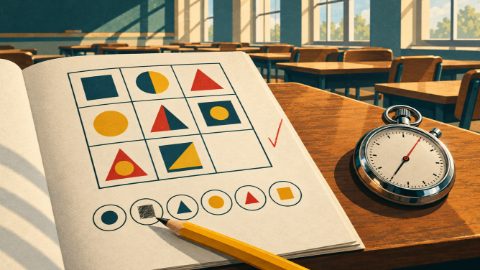
Here are more than 250 brain teasers and riddles with answers, sorted into eight kinds: easy brain teasers to warm up, hard ones for adults, logic puzzles, math teasers, lateral thinking puzzles, word riddles, number and pattern puzzles, and riddles for kids. Each answer stays hidden until you tap its puzzle, and under it a short explanation shows why it is right, so you can check your thinking and not just the answer.
Every teaser was written for this page and solved by a second reader who had not seen the answer, so each one has a single answer that the clues really lead to. The kinds below show a few puzzles each; open a kind for all of them. For ten new puzzles a day, Daily IQ is a free reasoning test with number series, patterns and odd-one-out questions, the same ten for everyone, and none of its puzzles is on this page.
Easy Brain Teasers
I have a space you can't stand in, an Escape you can't run out of, and an Enter that takes you nowhere. What am I?
Answer: A computer keyboard
Why: A keyboard has a Space bar, an Escape key and an Enter key, and none of them is a real place, exit or door.
I can show you whole mountain ranges and rivers, yet you can fold me flat and tuck me into a glove box. A little arrow on me points north. What am I?
Answer: A map
Why: A paper map shows mountains and rivers in miniature, folds up small, and usually has an arrow marking north.
Walk across a field of fresh snow and look back: every one of these you take has left its own mark behind you. What are they?
Answer: Footsteps (or footprints)
Why: Every step you take leaves a footprint in the snow behind you.
The more you dig out of me, the bigger I get, and if you fill me back in, I disappear. What am I?
Answer: A hole
Why: Taking dirt out makes a hole larger, and filling it in makes the hole vanish.
Your parents picked me out for you before you could even talk. I'm yours for life, yet your friends, family and teachers say me far more often than you ever do. What am I?
Answer: Your name
Why: Your name is yours, but family, friends and teachers say it much more than you ever say it yourself.
Hard Brain Teasers and Riddles
A builder puts up a square cabin with one window in each of its four walls, and every one of the four windows faces south. Where is the cabin?
Answer: At the North Pole
Why: At the North Pole every direction is south, so each wall faces south whichever way it is turned.
I have thirteen hearts, but none of them beat. I have four kings who rule nothing and four queens who wear no real crowns. What am I?
Answer: A deck of playing cards
Why: A standard deck has 13 cards in each suit, including hearts, and a king and a queen in each of its four suits.
My roots reach deeper than any tree's, I stand far taller than any tree, and yet no one has ever watched me grow. What am I?
Answer: A mountain
Why: A mountain's base runs deep into the Earth and its peak towers over every tree, but it grows far too slowly for anyone to see.
You can spend me, waste me, save me and lose track of me, but you can never stop me, and every clock keeps count of me. What am I?
Answer: Time
Why: We spend, waste and save time and lose track of it, and clocks measure it as it passes without ever stopping.
You are standing in a field, facing north. You turn right, then turn to face the opposite way, then turn left, and then turn left once more. Which way are you facing now?
Answer: East
Why: Turning right takes you from north to east, facing the opposite way takes you to west, the first left takes you to south, and the second left brings you back to east.
Logic Puzzles With Answers
Four kids ran a sack race: Ines, Kofi, Tomas and Wren. Tomas finished ahead of Wren but behind Ines, and Kofi crossed the line right after Wren. Who came in second?
Answer: Tomas
Why: Ines beat Tomas, Tomas beat Wren, and Kofi came in right after Wren, so the finishing order is Ines, Tomas, Wren and then Kofi.
Hana, Luis and Femi live in a row of three houses, and each keeps one pet: a parrot, a rabbit or a tortoise. The tortoise lives in the house between Hana's and Femi's, and Femi's pet can't fly. Who owns the parrot?
Answer: Hana
Why: The house between Hana's and Femi's is the middle one, so Luis keeps the tortoise. Femi's pet can't fly, so Femi has the rabbit, which leaves the parrot to Hana.
Lena's swim meet is the day after tomorrow, and it falls on a Sunday. What day of the week was the day before yesterday?
Answer: Wednesday
Why: Two days before Sunday is Friday, so today is Friday. Two days before Friday is Wednesday.
A prize is hidden in one of three boxes. Box A says, 'The prize is not in here.' Box B says, 'The prize is in Box A.' Box C says, 'The prize is not in Box B.' Only one of the three labels is true. Which box holds the prize?
Answer: Box B
Why: With the prize in Box A, the labels on B and C would both be true; with it in Box C, the labels on A and C would both be true. Only with the prize in Box B is exactly one label, the one on A, true.
Among four friends, Mo is shorter than Jun but taller than Ria, and Ria is taller than Sol. Who is the second shortest?
Answer: Ria
Why: From tallest to shortest the friends line up as Jun, Mo, Ria and Sol, so Ria is second from the bottom.
Math Riddles and Brain Teasers
I'm a two-digit number whose digits add up to 11. If you swap my two digits, I grow by exactly 27. What number am I?
Answer: 47
Why: Swapping the digits changes a number by 9 times the gap between them, so the digits differ by 3. Two digits that add to 11 and differ by 3 are 4 and 7, and 74 is 27 more than 47.
A mother is three times as old as her son. In 14 years, she will be exactly twice as old as he is. How old is the son now?
Answer: 14 years old
Why: If the son is s, then 3s + 14 = 2(s + 14), which gives s = 14. Check: today they are 14 and 42, and in 14 years they will be 28 and 56.
A store raises the price of a $100 jacket by 20%, then puts it on sale at 20% off the new price. What is the sale price?
Answer: $96
Why: The raise takes it to $120, and 20% off $120 is $24, leaving $96. The discount is taken from a bigger price, so it removes more than the raise added.
You toss three fair coins at once. What is the chance that all three land the same side up?
Answer: 1/4
Why: Three coins can land 8 equally likely ways, and only 2 of them, all heads or all tails, match. That is 2 out of 8, or 1/4.
A square's perimeter, measured in centimeters, is the same number as its area in square centimeters. How long is each side?
Answer: 4 cm
Why: With side s, the perimeter is 4s and the area is s times s. They are equal when s = 4, giving a perimeter of 16 cm and an area of 16 square cm.
Lateral Thinking Puzzles
Lena pushed her tiny metal dog onto a street that had a hotel on it, handed the owner a huge pile of money, and declared that she was bankrupt. She never left the kitchen table, and everyone around it cheered. What was going on?
Answer: She was playing a property board game, like Monopoly
Why: The tiny metal dog is a game piece. Landing on a street with a hotel means paying big rent, and running out of play money means going bankrupt.
Omar shaves more than twenty times every working day, yet he still has a long, thick beard. How?
Answer: He's a barber, shaving his customers
Why: Omar shaves other people's faces at work, not his own.
Mateo walked home through a downpour with no umbrella, no hood and no hat. His jacket was dripping when he got in, yet he didn't need to dry his hair at all. How?
Answer: He's bald
Why: With no hair on his head, there was no hair there to get wet.
Zara threw a tennis ball as hard as she could. It stopped, then came straight back to her hand, without bouncing off anything or touching anyone, and there was no string tied to it. How?
Answer: She threw it straight up
Why: Gravity slowed the ball down, stopped it at the top of its flight and pulled it straight back to her.
Tomas stepped off a 9-meter ladder with no harness, no net and nothing to land on but hard ground, and he didn't get a scratch. How?
Answer: He stepped off the bottom rung
Why: The ladder was 9 meters tall, but Tomas was standing on its lowest rung, just above the ground.
Riddles for Kids
I hang on the wall. I have a face and two hands, but I can't smile or wave. I go tick-tock all day long. What am I?
Answer: A clock
Why: A clock's face shows the numbers, and its two hands point to the time while it ticks.
You grab me when you get out of the bath. The more I dry you, the wetter I get. What am I?
Answer: A towel
Why: A towel soaks up the water from your skin, so it gets wetter while you get drier.
You have to crack me open before you can scramble me. What am I?
Answer: An egg
Why: To make scrambled eggs, you first crack the eggshell and pour out what's inside.
I have a thumb and four fingers, but no bones at all. I keep your hand warm when you play in the snow. What am I?
Answer: A glove
Why: A glove has a place for your thumb and each finger, but it's made of cloth or wool, not bones.
I have lots of little eyes, but I can't see a thing. You can mash me, bake me or cut me into fries. What am I?
Answer: A potato
Why: The small dark spots on a potato are called eyes, and potatoes become mashed potatoes, baked potatoes and fries.
Word Riddles and Word Teasers
Rearrange the five letters of CANOE to name a huge body of salt water.
Answer: OCEAN
Why: CANOE and OCEAN use exactly the same five letters in a different order. Fittingly, a canoe is something you might paddle on the water.
Which word for a dog ends with a hidden number?
Answer: Canine
Why: The last four letters of CANINE spell NINE.
If the word STAND is written directly above the letter I, what everyday phrase does it show?
Answer: I understand
Why: The letter I sits under the word STAND: I under stand, or I understand.
What kind of small boat, paddled by one or two people, has a name that reads the same backward as forward?
Answer: Kayak
Why: KAYAK spelled backward is still KAYAK, which makes it a palindrome.
Swap the first letters of the two words in 'belly jeans' to name a chewy candy.
Answer: Jelly beans
Why: Trading the B and the J turns 'belly jeans' into 'jelly beans'.
Number and Pattern Puzzles
Fill in the blank at the end of this run: 31, 28, 31, 30, 31, 30, ?
Answer: 31
Why: These are the numbers of days in January through June of a year that isn't a leap year. July comes next, and it has 31 days.
A dot moves around a small grid, where each / starts a new row. First the grid reads ●○○ / ○○○ / ○○○, then ○○● / ○○○ / ○○○, then ○○○ / ○○○ / ○○●. What does the next grid look like?
Answer: ○○○ / ○○○ / ●○○ (the dot in the bottom-left corner)
Why: The dot jumps clockwise from corner to corner: top-left, then top-right, then bottom-right. The next corner is bottom-left.
What comes next: D, N, O, S, A, ?
Answer: J
Why: These are the first letters of the months counted backward from December: December, November, October, September and August. Before August comes July.
What comes next: I, V, X, L, C, ?
Answer: D
Why: These are the letters used as Roman numerals, in order of value: one, five, ten, fifty and a hundred. The next is D, worth five hundred.
In this grid of numbers, every row, every column and both diagonals add up to the same total. The rows read 8 1 6 / 3 5 7 / 4 ? 2. What is the missing number?
Answer: 9
Why: The top row shows the total is 15. The bottom row then needs 4 + ? + 2 = 15, so the missing number is 9, which also makes the middle column 1 + 5 + 9 = 15.
How to use these brain teasers
With friends or family, read a teaser aloud and let everyone think in silence for a minute before anyone guesses; the first person to explain the answer, not just say it, wins the round. Lateral thinking puzzles work best as a game of yes-or-no questions: one person knows the answer and the others ask until they work it out.
In a classroom, the riddles for kids, the math teasers and the logic puzzles make good starters and early-finisher tasks. Ask students to write down how they got their answer, then compare it with the explanation under the answer.
On your own, try a few a day and give each one a real attempt before you look. Hard logic and pattern puzzles are easier on paper: write the clues down, draw a grid and cross out what cannot be true.
What makes a good brain teaser
A good teaser gives you everything you need and still makes you look at it in a new way: the answer feels obvious once you see it. That is the test each one here had to pass. A second reader solved every teaser without the answer, and any puzzle with a second answer that the wording allowed, a missing clue or a trick that relied on something the reader could not know was rewritten or dropped.
The number and pattern puzzles are built on ideas you will not meet in our daily IQ test, such as counting letters, reading clocks and calendars or looking at how numbers are written, so working through them never gives away a Daily IQ answer.
Common questions
What is a brain teaser?
A short puzzle that takes a moment of clear thinking rather than special knowledge: a riddle, a logic or math problem, a pattern to complete or a strange situation to explain. Most have a twist that makes the answer obvious once you see it.
How do I see the answers?
Tap or click a puzzle: its answer opens right under it, with a short explanation of why it is right. Tap it again to hide it.
What is the difference between a riddle and a brain teaser?
A riddle describes something in a puzzling way and asks what it is, and the answer usually turns on a double meaning. Brain teaser is the wider word: riddles, logic puzzles, math teasers, lateral thinking puzzles and pattern puzzles are all brain teasers.
Are there brain teasers for kids?
Yes. The riddles for kids page has short riddles in simple words for ages six to twelve, and the easy brain teasers suit older kids too.
Is there a puzzle game I can play every day?
Yes. Daily IQ deals ten new reasoning puzzles every day at midnight New York time, the same for everyone, and the IQ-style test page explains how it scores. The brain games page has more.
Trivia questions · Which came first? · Quiz games · Brain games · 290+ puzzles, updated November 9, 2026