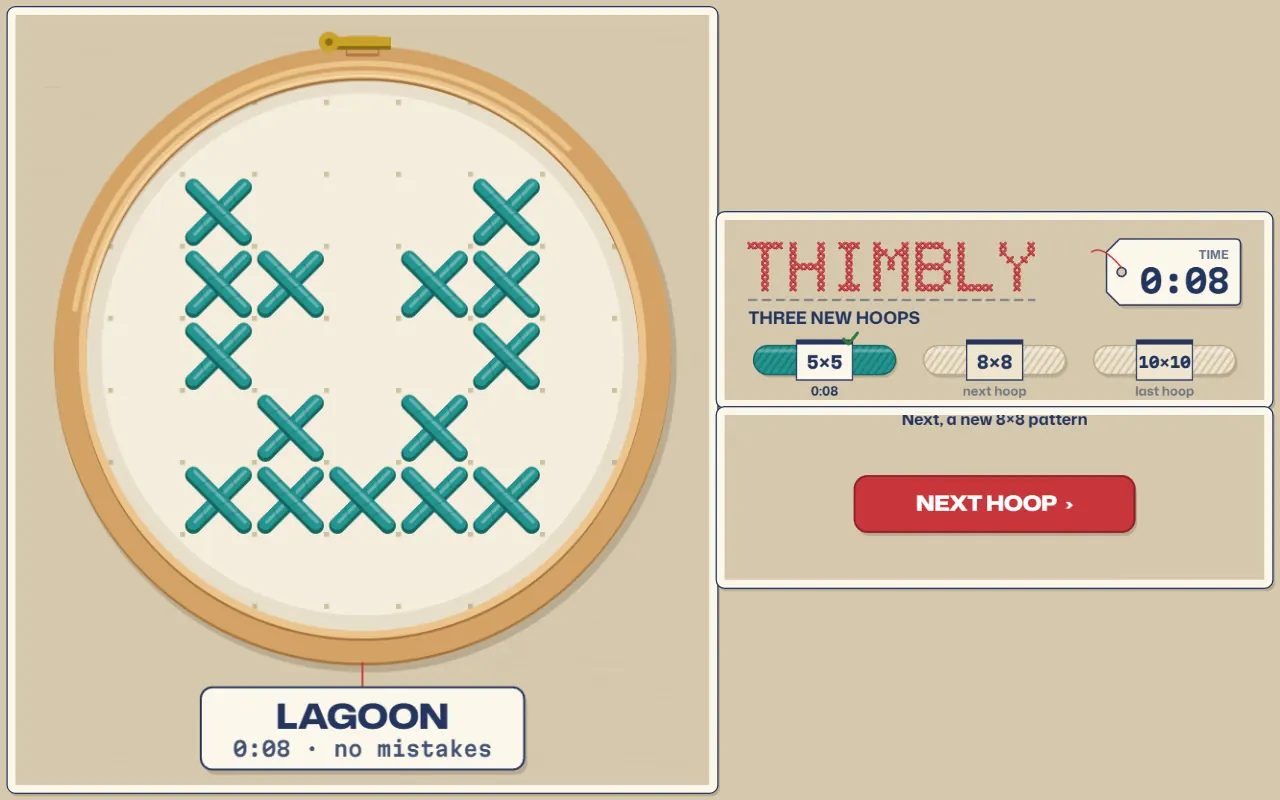
Thimbly is a nonogram, a picture-logic puzzle, dressed as cross-stitch. Each hoop is a chart with thread counts along its rows and columns, telling you how many stitches go in each line and in what runs. Work out which squares must be stitched and which must stay bare, and when the pattern is complete the red working stitches turn into a little embroidered motif in its wooden hoop. A day is three hoops: a 5×5, an 8×8 and a 10×10.
Version one: Stitch and its hand-drawn charts
The game arrived on 14 October 2026 as Stitch, with the first set of our daily games. Its days came from a library of 418 hand-drawn charts. Hand-drawn motifs look lovely, and that was the problem: some are much harder to solve than others of the same size, and nothing in a drawing tells you which. A daily game where one day is three times harder than the next has a leaderboard that mostly measures the calendar.
Version two: every set made fresh
On 19 October a playtest note said Stitch should not be a daily game at all: it should make a new puzzle every time someone played. So it learned to generate its own. Each run drew its three patterns from its own seed: a mirror-symmetric motif, smoothed into shapes on the bigger charts, and kept only if it passed three tests.
- One solution, by logic alone. Reading the lines one at a time must solve the whole chart, with no guessing.
- Counts that fit. The thread counts have to fit the chart's margins.
- A grade inside the size's band. Each pattern is graded on how full it is, how many counts it has, how many rounds of line logic it needs and how many strokes a line-by-line stitcher needs, and it must fall inside a band centred on the middle of the old hand-drawn charts.
The strokes turned out to be what matters. How long a steady player takes on a hoop follows its stroke count very closely, so the bands hold strokes tight: 7 to 9 for a 5×5, 16 to 19 for an 8×8, 24 to 28 for a 10×10. The hand-drawn charts, graded the same way, had mostly spread from 4 to 14, 10 to 25 and 16 to 41 strokes. Measured over 24 seeds, the same steady player's time for a whole set now varies by a factor of only 1.14 between the slow end and the quick end.
With fresh sets every play, Stitch was no longer a daily game, and it left the Daily Games page. The motifs also gained colour: each one is painted in one of sixteen colourways, named on its tag.
Into The Daily
On 3 November we changed the rule for which games The Daily can deal: any game qualifies as long as every run has a time limit. Stitch's runs already stopped at 20 minutes, so it qualified, and from 6 November it could be dealt. Because it had no day of its own then, its slot in The Daily simply played three hoops from The Daily's secret seed.
Version four: Thimbly, a daily again
On 8 November we decided it should be a daily game after all, now that a daily could be fair, and that it needed a better name. It became Thimbly, after the thimble. Its address moved to /game/thimbly, and the old one sends you there.
The generator stayed. What changed is where a day's hoops come from: a table four years long, built from generated, graded hoops, in which no hoop of a size comes back on another day. There are 2,233 different 5×5 patterns that pass the tests, counting one turned over as the same, and the four-year table uses 1,461 of them. Measured on the 120 days of hoops from 9 November, the table's hoops are as hard as fresh ones.
Everyone now gets the same three hoops each New York day, with one try, and The Daily draws its own three from its secret seed, a week clear of the game's own days in either direction.
How it scores
Finished hoops come first and time second: three hoops in any time beat two hoops in any time, and between two players with the same number of hoops, the quicker set ranks higher. The clock never stops, and a set ends at 20 minutes if you have not finished. If you are stuck, CHECK, pressed twice, unpicks every wrong stitch in the hoop, at the cost of 15 seconds on your time.
Looking back, the turns in Thimbly's story were all about fairness. Hand-drawn charts made unequal days. Generated, graded hoops made equal ones, and once they were equal, the game could be a daily again.