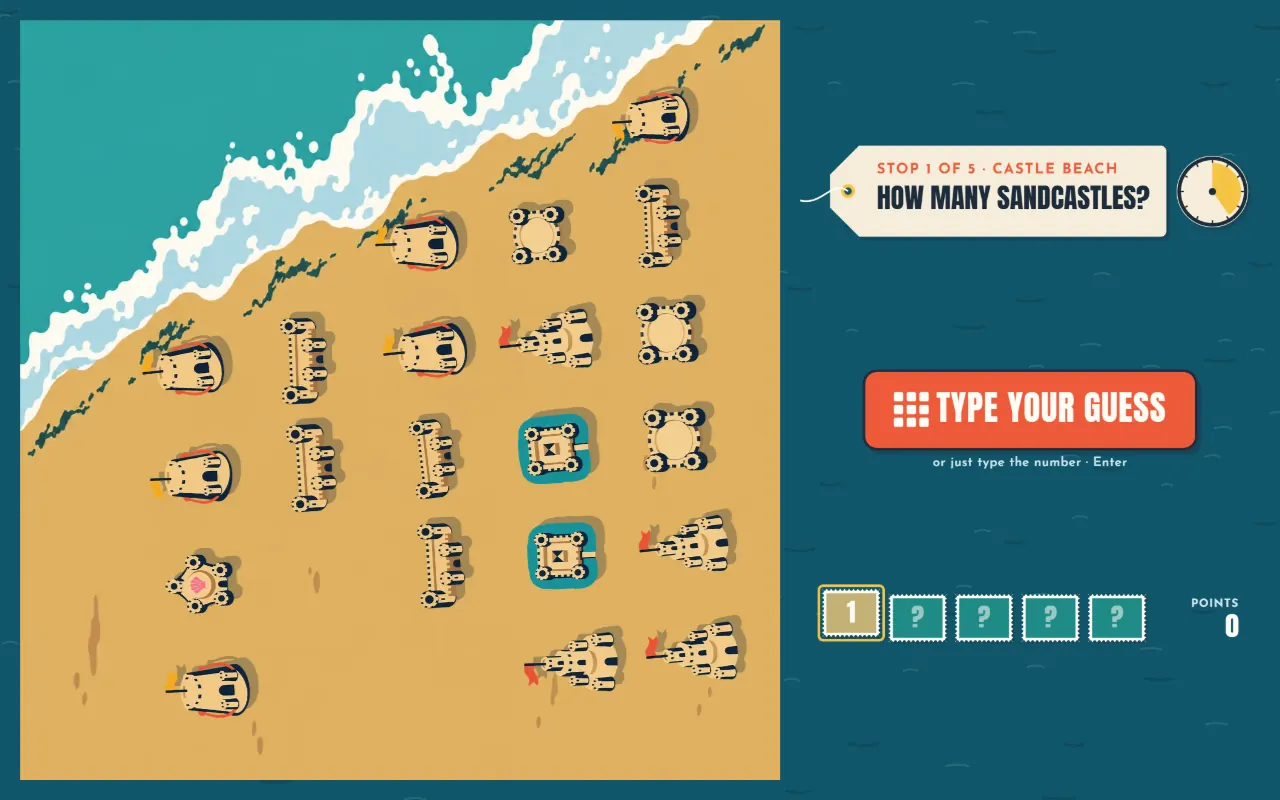
How Many is a seaplane hop along an imaginary coast with five stops. At each one the shutter opens on a scene seen from straight above, it holds still for a few seconds, and then it shuts. You type how many of the day's items there were, and the game ticks every one of them as it counts up to the truth. Because the answer has to be exact, we cannot use real photographs. Every scene is put together by the game itself, from a seed, at the moment you play it.
What a scene is made of
A scene starts from a subject: the thing you count, with its place in the world, like umbrellas on a beach or boats in a marina. The game has 369 subjects in six worlds: the coast, the sea, the city, the land, the ice and the river. Each subject comes with two or three illustrated grounds for it, called plates, 787 in all, and five or six drawings of the item itself so that a crowd of them does not look stamped out.
Each subject also says how its items gather. There are six layouts: scattered, in clusters, as a flock, in rows, in a grid or along a path. Each layout has eight styles. A scatter can thin out to one side, crowd into the middle or leave empty patches; clusters can come in twos or eights or in three very different sizes; rows can be full at one end and nearly empty at the other. A subject on one plate in one layout is one picture, and there are 2,201 of them.
Placing every item
Once the stop has its subject, plate, layout and count, the game places the items one by one with the scene's own random numbers. It works out how big each item should be from the count, then finds spots for them. Every item must sit on the plate's real ground, so it lands where it belongs on that picture: each plate carries a small map of where its ground is, measured from its own art. Items also keep clear of the frame, so nothing is cut off at the edge.
No two items overlap: each one keeps a clear gap around it. If the spots run out before the count is reached, the items shrink by 6% and the game tries again, up to 24 times, but never below a size you can still see on a phone. The count shown in the reveal is always exactly the number placed. Our tests check that every subject's limits leave room for the largest count it can be dealt.
Finally the whole scene is turned to one of eight headings, four quarter turns each mirrored or not, so the same picture never looks quite the same twice.
The five stops get bigger
| Stop | Items | Shown for |
|---|---|---|
| 1 | 10 to 35 | 5 seconds |
| 2 | 36 to 99 | 6 seconds |
| 3 | 100 to 299 | 7 seconds |
| 4 | 300 to 599 | 8 seconds |
| 5 | 600 to 1,600 | 9 seconds |
The first stop is nearly countable on purpose. After that you are estimating, and the snapshot stays perfectly still the whole time it shows: no pan, no zoom, no drift. Once it closes you have 9 more seconds to type your number.
The same five for everyone, and no repeats
Each day's five stops come from a deck planned 1,830 days ahead, from 28 October 2026. In it, a subject does not come back within 60 days, and a single picture does not come back within 365; when one does return, it takes a style it has not shown before. A day never has two subjects of the same group, and at most two of one world, three of the land.
How a guess is scored
How Many scores by how far off you are as a ratio, not a difference. Guessing half the true number costs exactly as much as guessing double. An exact guess scores 1,000 points. A guess 5% too high scores 833 (5% too low, a hair less), 10% too high 714, 25% too high 500, double or half 200, and ten times off either way 27. No guess scores 0. Five stops make 5,000 at most.
The postmark on each stop grades the same ratio: SPOT ON within 5%, CLOSE within 15%, NEAR within 40%, and FAR OFF beyond.
Tips that follow from the scoring
- Count a patch, then multiply. In the seconds you have, count the items in a small part of the scene and judge how many such parts fill it.
- Watch the layout. Clusters, flocks and uneven rows make density hard to read. Check whether the items thin out to one side before you multiply.
- Commit to one number. Because the score is a ratio, a hedge between two estimates usually does worse than your better estimate.
- Never leave it blank. Ten times off still scores 27, and a blank scores nothing.
The share card shows a postmark for each stop and your points, never a count or a subject, so sharing your day gives nothing away. Once your run has finished, the postcard at the end adds everyone's guesses for each stop and the crowd's middle guess, so you can see whether the whole crowd fell for the same scene.