A leaderboard looks simple: a list of names and scores, best first. Underneath it there are a few decisions that matter a lot once real players fill it: which runs count, what happens when a game changes, and above all who goes first when two scores are equal. This is how ours work.
Which boards a game has
A game with leaderboards has an all-time board and a board for each week, and a daily game also has a board for each day. A week runs Monday to Sunday and a day midnight to midnight, both on New York time. Racing games, where finishing faster is the point, also get a Fastest board ranked by time. The Daily has one board per day of its own.
On a normal board you appear once, with your best run. On a board where you only get one try, a daily game's day board or The Daily, your entry is your first and only run. A board shows 50 rows a page by default, and you can switch to 20 or 100.
Who is on the boards
Everyone who plays, including guests. A guest appears under a random name made of an adjective, an animal and a few digits, with a small guest tag after it. Names are drawn at random from family-friendly word lists and checked against a profanity filter; they are never based on your address or your device. Sign up later on the same browser and your entries stay, under your account's name.
Guests go through exactly the same replay check as accounts, and two limits keep a board honest. A browser gets one try a day at a daily round, so starting over as a new guest on the same browser does not buy a second place. And one network can put at most 1,000 guests on a board in a day, far more than a school, an office or a busy household needs, which only stops a script from filling a board.
Rule changes do not wipe the boards
We change games often, and a board is not reset when we do. A board belongs to the game, the mode and the period, not to a version of the rules, so new runs post to the same board as old ones. Each day is still played at one fixed version, so everyone on a day's board played by the same rules.
The exception is a change to what a score means. If a new version's scores are on a different scale, old scores could sit on top forever, out of reach. Then we either rebuild the game's boards from the new version's runs, or, when the old runs hold everything needed, convert every old score to the new scale so nobody is wiped off.
How ties are broken
A higher score always ranks first. For an equal score, each game uses one of three rules:
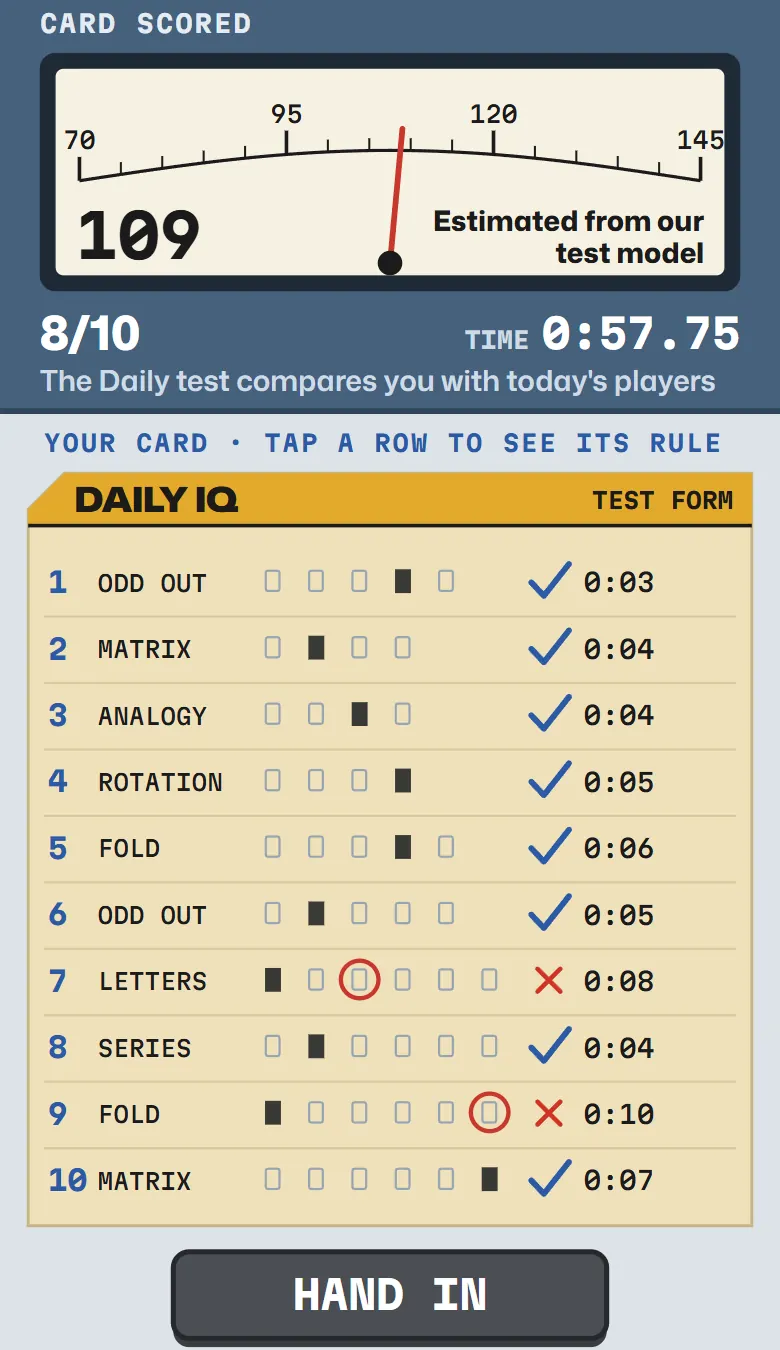
- Fastest. Less time spent playing wins. Only the time you actually had control counts: in Uncommet the seconds each prompt was open for typing, in Daily IQ the time each question was on screen, in Purrglar the planning time. Animations, reveals and result screens never count.
- Soonest. For games where every run lasts the same length, like a fixed two-minute clock, total time would tie everyone. So the clock counts only up to the moment your score last changed: whoever reached the score first ranks first. Mate in One works this way.
- First come. In a game without a time tie-break, equal scores share a place and are listed by who finished first.
The time used for a tie is measured by the game's own code and checked again when our servers replay the run, so it cannot be edited. Where it is used, a row whose score ties the row above or below it shows its play time under the score, to the hundredth of a second.
When two runs are exactly equal, the same score in the same number of ticks, they share a place and the next place is skipped: 1, 2, 2, 4. On The Daily's board, equal totals are split by less total time played and then by who finished first.
Verified and unverified
A run appears on a board as soon as it ends, marked unverified until our servers have replayed it from its inputs. If the replay matches, it becomes verified. If it does not, it comes off the board, and the player's entry falls back to their best verified run.
Board pages have a Friends only key to show just the people you have added, and when a board runs to several pages, Show me takes you to the page with your row. A guest sees its real place too, with a reminder that an account keeps it.