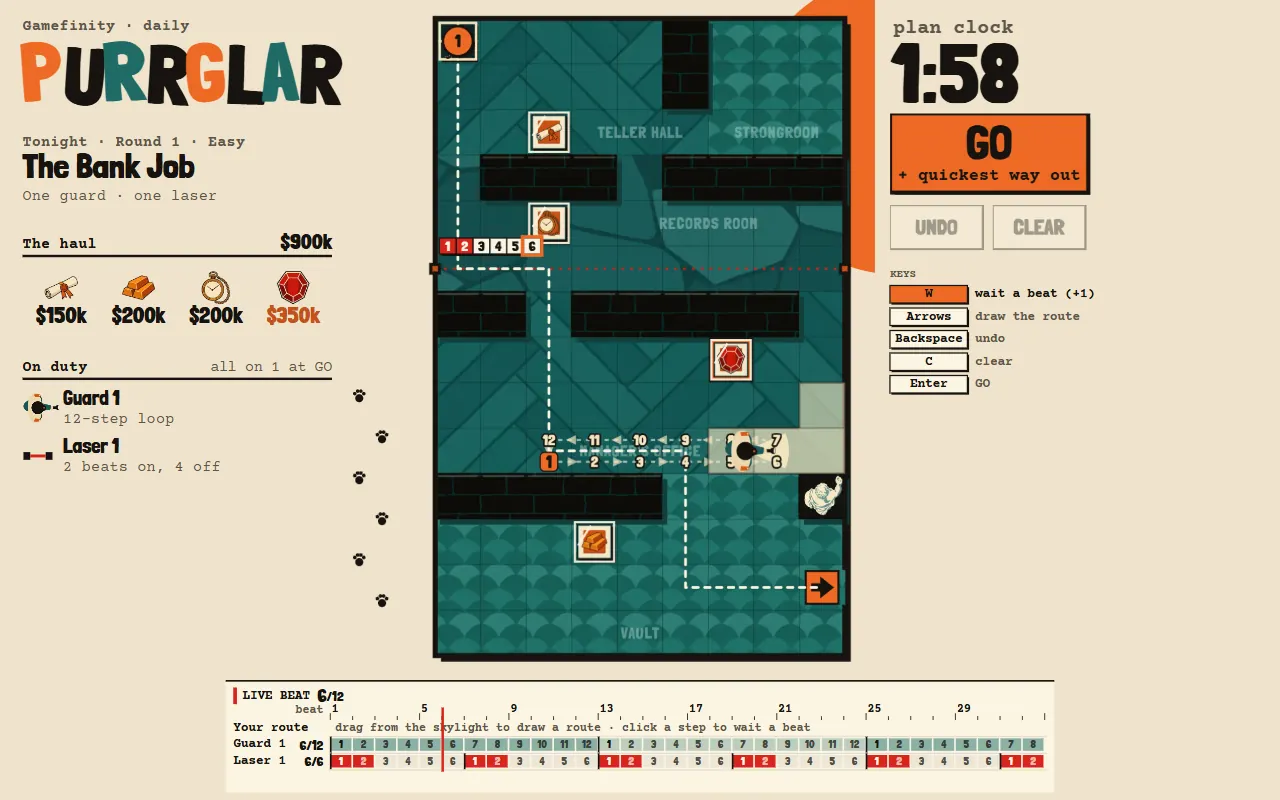
Purrglar is a heist puzzle for a cat burglar. You see a building from above, with guards, cameras, lasers and a sleeping dog, and you draw the cat's route through it beat by beat: in through the skylight, over the display cases and out of a door. Then you press GO and watch your plan play out. Nothing moves while you plan except the traps' cycles, which you can study for as long as the clock allows.
It started life as a prototype called Caper, a single web page we could change in minutes and play straight away. Every version of it was kept, which is how we can tell its story with dates.
The first version: fun, but unfair
The first prototype, on 4 November 2026, already had the core idea: a planning phase with a 90-second clock, then the watch. Playtesters liked it straight away, and their complaints were specific. The plan did not make it clear where each trap would be when the run began, so a route that looked safe could walk into a guard. And picking up the loot took an extra beat, which broke the rhythm of a route you had counted out.
Both fixes became rules that Purrglar still has. Every trap runs a numbered cycle, one step a beat, and every trap is on step 1 when the cat drops in, every run, with no random start. The plan shows each trap's numbered positions, so you can count a route out exactly before you press GO. And stealing costs no time: walking onto a case bags it on that same beat.
The preview we removed
The third version tried to help more. It added a beat bar you could scrub through: pick any beat of your plan and the map showed where every trap would be at that moment. It was clever, and in play it made the game too easy. With every future beat one drag away, planning stopped being a puzzle you hold in your head and became a matter of checking frames until nothing turned red.
So the next version went back to the second one's way of showing traps and kept only a few rule changes. A route can wait on a tile for at most one extra beat, the wait counts as a beat, and the plan clock became two minutes. On 6 November the rules were locked, and the last prototype, a tidier layout with the same rules underneath, is what the game is built on.
Into the site
On 7 November the prototype was rebuilt as a real Gamefinity game. That meant moving the rules into the deterministic code every one of our games runs on, so that a heist plays out exactly the same on any device and our servers can replay and check every run. The game also got a solver: an exact search that finds the fewest beats in which a heist's whole haul can be done. We never show its route; it only gives the game a number to measure your plan against.
The solver also builds the days. Each day's heists come from a deck of generated buildings, and each one is kept only if the solver can measure it into its difficulty band. An Easy heist has 2 to 3 traps, a best route of 26 to 46 beats, and a sloppy first try that works at least some of the time. A Hard heist has 3 to 5 traps, a best of 32 to 60 beats, and almost no sloppy try that works.
There was a detour on the way. The first build tried a new cut-paper art set and a calmer layout. The same day we went back to the prototype's own art and type, and kept them. Purrglar went public on 8 November 2026, which is night No. 1.
One game, two rounds, real points
At launch, Easy and Hard were two separate modes with their own boards, and the score was the cash carried out, with numbers in the hundreds of thousands. Within a day that looked wrong next to our other games. On 8 November it became one game of two rounds, the Easy heist and then the Hard heist, on one board, scored in points like everything else on the site.
Each round is worth up to 1,000 points. 700 of them are for the loot you carry out, and 300 more for how close your route came to the solver's best, which only counts on a clean getaway. A noisy getaway, where the cat was seen but got out, keeps half the loot. A round that ends with the cat caught costs 250 points, because getting caught should hurt. The two rounds add up to at most 2,000, never below 0.
With a perfect plan worth the same on everyone's board, ties at the top were certain, so two equal scores rank by planning time: the quicker plan ranks first.
In The Daily, and small fixes
When Purrglar is dealt into The Daily it plays exactly as it does on its own page, both rounds with the same clocks, but on a pair of heists of its own that no day of the game uses. The last changes were small: nothing drawn over the skylight where a route starts, and a clear "+1" to make the cat wait a beat.
Looking back, the pattern is clear. The parts that make Purrglar fair, traps that always start on step 1 and loot that costs no time, came from the first playtest. The part that makes it a puzzle came from removing a tool that did the thinking for you.