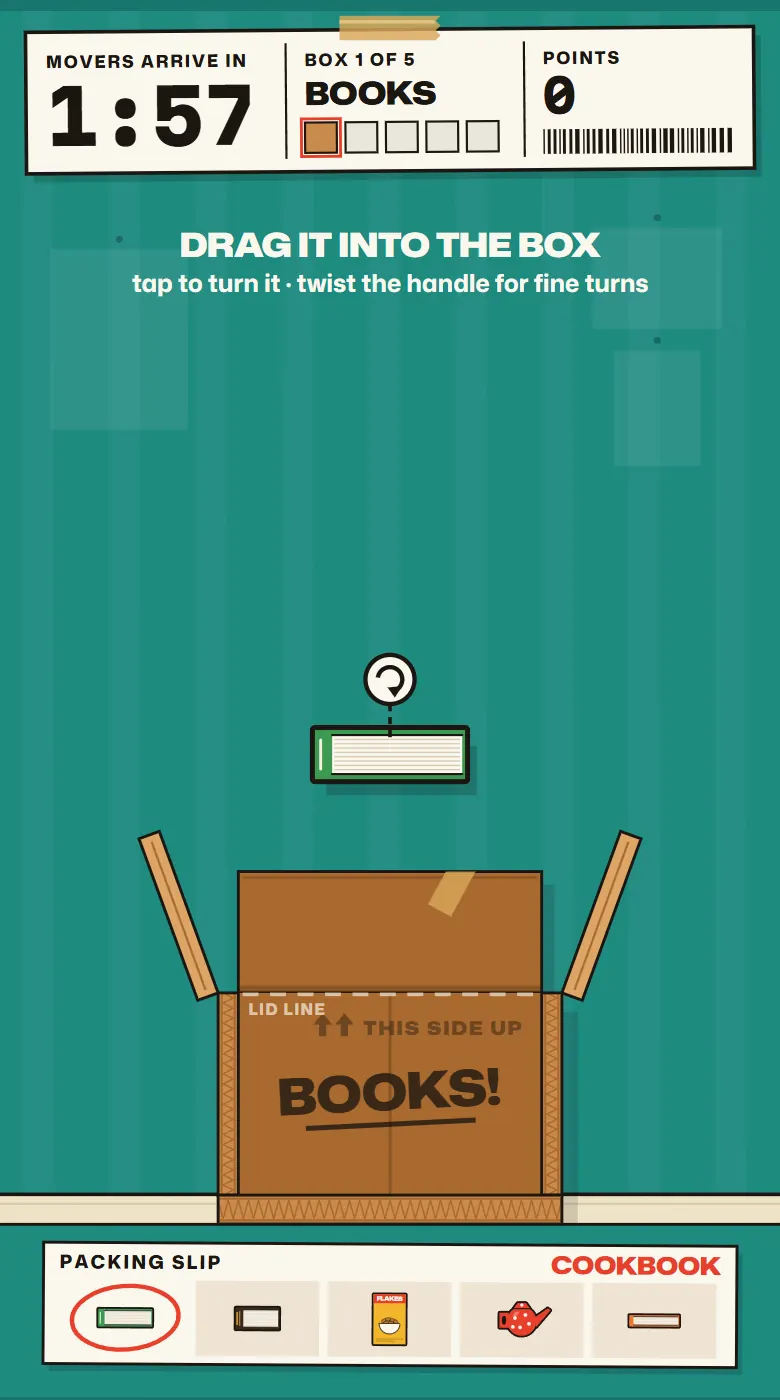
Pack It is moving day. Objects wait on a packing slip, from books and a teapot to a bathtub or a double bass; you drag each one over a cardboard box, turn it, let go, and real physics settles it on the pile. When everything is in and below the lid line, the box is taped and the next one rolls in. It arrived with our Daily Games hub on 14 October 2026, and for a few weeks it seemed fine. Then we looked at it properly.
The problem
On 8 November 2026 a playtest verdict came back blunt: the concept was good, but the game played badly, because it was far too easy. The numbers agreed. The first two boxes held four small objects that filled only a fifth to a quarter of the box, and our test player, a bot that plays like a decent human, taped them clean in 48 tries out of 48. Boxes three and four held five objects, filled under half the box and were taped clean 30 times in 48. The order you packed in was fixed, and the 95-second clock was about four times what a good packer needed.
A game where everyone scores near the top has a meaningless leaderboard, and Pack It was also one of the games dealt into The Daily. It needed to get harder, but in the right way: through planning, not through fiddly controls or lucky physics.
First round: tight boxes, any order
The same day, the game was rebuilt around boxes with only just enough room. You can now pack the objects in any order: tap one on the slip to take it in hand. And every box is built together with a proof that it can be done. An expert player, a search that tries every object still to pack, in many spots and at every sixteenth of a turn, playing the game's real physics, has to pack each box clean, both as dealt and as its mirror image. Its pile height becomes that box's par.
After playing it, we asked for three more changes. Pack It became a daily game only, the Endless mode went, and a day became five boxes holding 5, 5, 6, 6 and 7 objects on one movers' clock of exactly 2:00. And each box slot draws from its own rotation of 367, 373 or 379 sets, numbers chosen so the rotations rarely line up, so no box comes back within 365 days.
Second round: the random thrower
On 9 November the five-box version got a second verdict: still too easy, because you could throw everything in at random, without turning anything, and score high. Our measurements had missed this because our test player was trying to play well. So we added players who do not.
- The expert: the search above, which proves every box can be packed clean and sets its par.
- The decent bot: packs the biggest thing first, considers every eighth of a turn, and makes a human's mistakes now and then.
- The dropper: packs in the slip's order, never turns anything, and lets go at a random spot as fast as it can.
- The aimer: also never turns anything, but drops each object at the lowest landing it can find.
- The newcomer: turns things a little, slower and sloppier than the decent bot.
Every candidate box is now played by all of them, and its lid is set as low as the dropper needs to fail: the dropper may tape the first box clean at most 5 times in 48 tries, the second at most 3 times and the last three at most once. The aimer has to fail most of the later boxes. And the first box must stay fair for someone new: the newcomer has to tape it clean at least half the time. A box is kept only if every one of those holds, and the expert still packs it clean.
What the numbers say now
Across the five slots, the objects now fill 55% to 58% of each box on average; before the rework the first four boxes were 20%, 28%, 43% and 45% full. Over 240 boxes from 48 whole days, the dropper tapes 9 clean, the aimer 26, the newcomer 57 and the decent bot 91.
The scoring changed to match. A clean box scores 1,000, plus a tightness bonus of up to 1,000 for how far your pile stays under the lid compared with the expert's pile. A box that ends overstuffed, spilled or unfinished when the movers arrive scores 0. Time left on the clock pays a speed bonus, 10 points a second when all five boxes are clean and less for fewer. The most a day can score is 11,200.
Nothing alive in the boxes
One more note from the same playtest: never put live animals in the boxes. The cat, the fishbowl, the potted plant and the lawn flamingo became a vacuum cleaner, a snow globe, a gumball machine and a mailbox, and a test now fails if any living thing ever reaches a box. Eleven new objects joined at the same time, from a cookbook to a washing machine, so every slot has a year of new, harder boxes.
What we took from it: measuring a game with a player who plays well tells you a game is winnable. To know it is hard, you also have to measure the player who does not try.