36 puzzles with answers · tap one to see its answer
Number and Pattern Puzzles
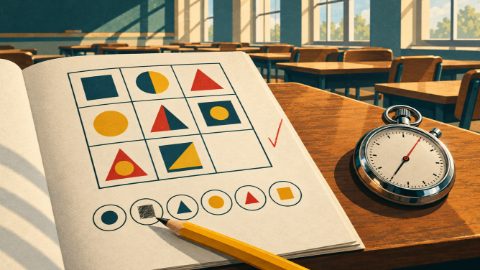
These 36 number and pattern puzzles ask what comes next or what is missing, in sequences, rows of symbols and small grids written as text. The rules are not the usual add-three or double-it: they hide in how numbers are written and spoken, in clocks and calendars, in letters and in the shapes themselves. Each answer explains the rule.
Every puzzle was solved by a second reader who had not seen the answer, on November 9, 2026.
Fill in the blank at the end of this run: 31, 28, 31, 30, 31, 30, ?
Answer: 31
Why: These are the numbers of days in January through June of a year that isn't a leap year. July comes next, and it has 31 days.
A dot moves around a small grid, where each / starts a new row. First the grid reads ●○○ / ○○○ / ○○○, then ○○● / ○○○ / ○○○, then ○○○ / ○○○ / ○○●. What does the next grid look like?
Answer: ○○○ / ○○○ / ●○○ (the dot in the bottom-left corner)
Why: The dot jumps clockwise from corner to corner: top-left, then top-right, then bottom-right. The next corner is bottom-left.
What comes next: D, N, O, S, A, ?
Answer: J
Why: These are the first letters of the months counted backward from December: December, November, October, September and August. Before August comes July.
What comes next: I, V, X, L, C, ?
Answer: D
Why: These are the letters used as Roman numerals, in order of value: one, five, ten, fifty and a hundred. The next is D, worth five hundred.
In this grid of numbers, every row, every column and both diagonals add up to the same total. The rows read 8 1 6 / 3 5 7 / 4 ? 2. What is the missing number?
Answer: 9
Why: The top row shows the total is 15. The bottom row then needs 4 + ? + 2 = 15, so the missing number is 9, which also makes the middle column 1 + 5 + 9 = 15.
In this word ladder, each step changes exactly one letter, and the ladder ends at the opposite of where it started: COLD, CORD, WORD, WORM, ?
Answer: WARM
Why: Each step swaps one letter, and changing the O of WORM to an A gives WARM, the opposite of COLD.
Which word is the odd one out: radar, level, civic, motor, refer?
Answer: Motor
Why: Radar, level, civic and refer are palindromes, reading the same backward as forward. Motor read backward is rotom.
Which is the odd one out: hexagon, triangle, circle, square, pentagon?
Answer: Circle
Why: The hexagon, triangle, square and pentagon are all made of straight sides that meet at corners. A circle has a single curved edge and no corners at all.
Each row and each column of this grid holds one circle, one triangle and one square. The rows read ○ △ □ / △ □ ○ / □ ○ ?, where each / starts a new row. Which shape replaces the question mark?
Answer: △ (a triangle)
Why: The bottom row already has a square and a circle, so it needs a triangle. The last column, □ then ○ then ?, agrees.
Coins and banknotes in many countries come in these values: 1, 2, 5, 10, 20, 50, ?
Answer: 100
Why: The values repeat a 1, 2, 5 pattern, with each round ten times bigger than the one before. After 10, 20 and 50 comes 100.
What comes next: 1, 4, 9, 61, 52, 63, 94, ?
Answer: 46
Why: These are the square numbers from 1 up to 49 with their digits reversed, so 16 becomes 61 and 25 becomes 52. The next square, 64, reversed is 46.
Counting around a clock face, which number follows 9, 2, 7, 12, 5?
Answer: 10
Why: Each step moves the hour hand 5 hours forward: 5 hours after 9 o'clock is 2 o'clock, then 7, then 12, then 5. Five hours after 5 is 10.
On a phone keypad (2 is ABC, 3 is DEF, and so on up to 9 for WXYZ), JAN is typed 526, FEB is 332 and MAR is 627. What number is APR?
Answer: 277
Why: Each letter becomes the key it sits on. A is on the 2 key, and P and R both sit on the 7 key, so APR is 277.
In this puzzle, ■□■ + □■■ = ■■□ and □□■ + ■□■ = ■□□. Following the same rule, what is ■■□ + ■□■?
Answer: □■■
Why: Compare the rows square by square: the result is black only where exactly one of the two squares is black. In ■■□ + ■□■ the first places are both black, giving white, while the second and third places each have one black, giving black.
What comes next: eight, five, four, nine, one, ?
Answer: Seven
Why: These are the numbers one to ten sorted into alphabetical order. After 'one' comes 'seven', then six, ten, three and two.
What comes next: O, N, E, T, W, O, T, H, R, E, E, F, ?
Answer: O
Why: Run the letters together and they spell ONE, TWO, THREE and the start of FOUR. After the F of FOUR comes O.
What comes next: T, S, N, T, F, ?
Answer: E
Why: These are the first letters of the multiples of 3 written as words: three, six, nine, twelve and fifteen. The next multiple is eighteen.
If CAB = 6, BAD = 7 and ACE = 9, what does BADGE equal?
Answer: 19
Why: Each letter is worth its place in the alphabet (A = 1, B = 2 and so on), and a word is worth the sum of its letters. BADGE is 2 + 1 + 4 + 7 + 5 = 19.
What comes next: 1, 10, 11, 100, 101, 110, ?
Answer: 111
Why: This is counting from one to six in binary, where each place is worth double the place to its right. Seven in binary is 111.
What comes next: 39, 132, 363, 726, ? (Each step uses the number's own digits.)
Answer: 1353
Why: Each term is the one before plus that number written backward: 39 + 93 = 132, 132 + 231 = 363 and 363 + 363 = 726. Next comes 726 + 627 = 1353.
Two 4-letter fruits are woven together here, taking one letter from each in turn: KPIEWAIR. What are the two fruits?
Answer: Kiwi and pear
Why: The 1st, 3rd, 5th and 7th letters spell KIWI, and the 2nd, 4th, 6th and 8th spell PEAR.
On a standard US keyboard, holding Shift and pressing the number keys from left to right types ! then @ then # then $. Which symbol comes next?
Answer: %
Why: The next key along the top row is 5, and Shift with 5 types the percent sign.
A typist's hands slipped one key to the right on a QWERTY keyboard, so instead of the name of a common pet she typed VSY. What did she mean to type?
Answer: CAT
Why: On a QWERTY keyboard, V sits just right of C, S just right of A, and Y just right of T. Shift each letter one key back to the left and VSY becomes CAT.
What Comes Next In This Sequence: W, C, N, I, T, ?
Answer: S
Why: The letters are the first letters of the words in the question itself: What Comes Next In This Sequence. The last word, Sequence, starts with S.
A plain clock with no numbers on its face is seen in a mirror, and it appears to show 3:40. What time is it really?
Answer: 8:20
Why: A mirror flips the clock from left to right, so the real time and the mirrored time always add up to 12:00. And 12:00 minus 3:40 is 8:20.
What comes next: 3, 13, 1113, 3113, 132113, ? (Try describing each term out loud.)
Answer: 1113122113
Why: Each term reads the one before it aloud. 132113 is one 1, one 3, one 2, two 1s and one 3, which is written 11 13 12 21 13.
What comes next: 6788, 2688, 768, 336, 54, ?
Answer: 20
Why: Each term is the product of the digits of the one before: 6 x 7 x 8 x 8 = 2688, then 2 x 6 x 8 x 8 = 768, and so on. The digits of 54 multiply to 20.
What comes next: 16, 23, 28, 38, 49, ?
Answer: 62
Why: Each term adds its own digits to itself: 16 + 1 + 6 = 23, then 23 + 2 + 3 = 28, and so on. So the next term is 49 + 4 + 9 = 62.
What comes next: 23, 11, 6, 3, 5, ? (Think about the words, not the numbers.)
Answer: 4
Why: Each term counts the letters of the one before it spelled out: twenty-three has 11 letters, eleven has 6, six has 3, three has 5 and five has 4. Four has 4 letters, so the sequence stays at 4 forever.
What comes next: 1, 2, 3, 2, 1, 2, 3, 4, 2, ? (Hint: think about how the Romans wrote the numbers 1 to 10.)
Answer: 1
Why: Each term counts the characters in a Roman numeral, from I, II and III up to VIII and IX. The tenth numeral, X, has just one character.
On a 24-hour digital clock, these times read the same backward and forward: 10:01, 11:11, 12:21, 13:31, 14:41 and 15:51. What is the next time of day that does?
Answer: 20:02
Why: Following the pattern would give 16:61, 17:71, 18:81 and 19:91, but no clock shows more than 59 minutes. The next time that reads the same both ways is 20:02.
If CAT = 1, DOG = 2, FISH = 0 and BOX = 3, what does BREAD equal?
Answer: 5
Why: Count the closed holes in the capital letters: A, D, O and R have one each, B has two, and the rest have none. BREAD scores 2 + 1 + 0 + 1 + 1 = 5.
What comes next: ↑ ↘ ← ↗ ↓ ↖ → ?
Answer: ↙ (pointing down and to the left)
Why: Each arrow turns 135 degrees clockwise from the one before, three eighths of a full turn. Turning → another 135 degrees clockwise points it down and to the left.
In a year that isn't a leap year and starts on a Saturday, the first days of January to June fall on Saturday, Tuesday, Tuesday, Friday, Sunday and Wednesday. On what day does October 1 fall?
Answer: Saturday
Why: A month of thirty days pushes the following month's first day two weekdays later, and a month of thirty-one days pushes it three. June, July, August and September take Wednesday on to Friday, Monday, Thursday and finally Saturday.
What comes next: M, T, S, W, S, T, ?
Answer: F
Why: Start on Monday and jump ahead three days each time: Monday, Thursday, Sunday, Wednesday, Saturday and Tuesday. Three days after Tuesday is Friday.
What comes next: 3524, 3087, 8352, 6174, ? (Each term is built from the digits of the term before.)
Answer: 6174
Why: Arrange a term's digits from largest to smallest and subtract the smallest arrangement: 5432 - 2345 = 3087, then 8730 - 0378 = 8352. For 6174 that gives 7641 - 1467 = 6174 again, so it repeats forever.