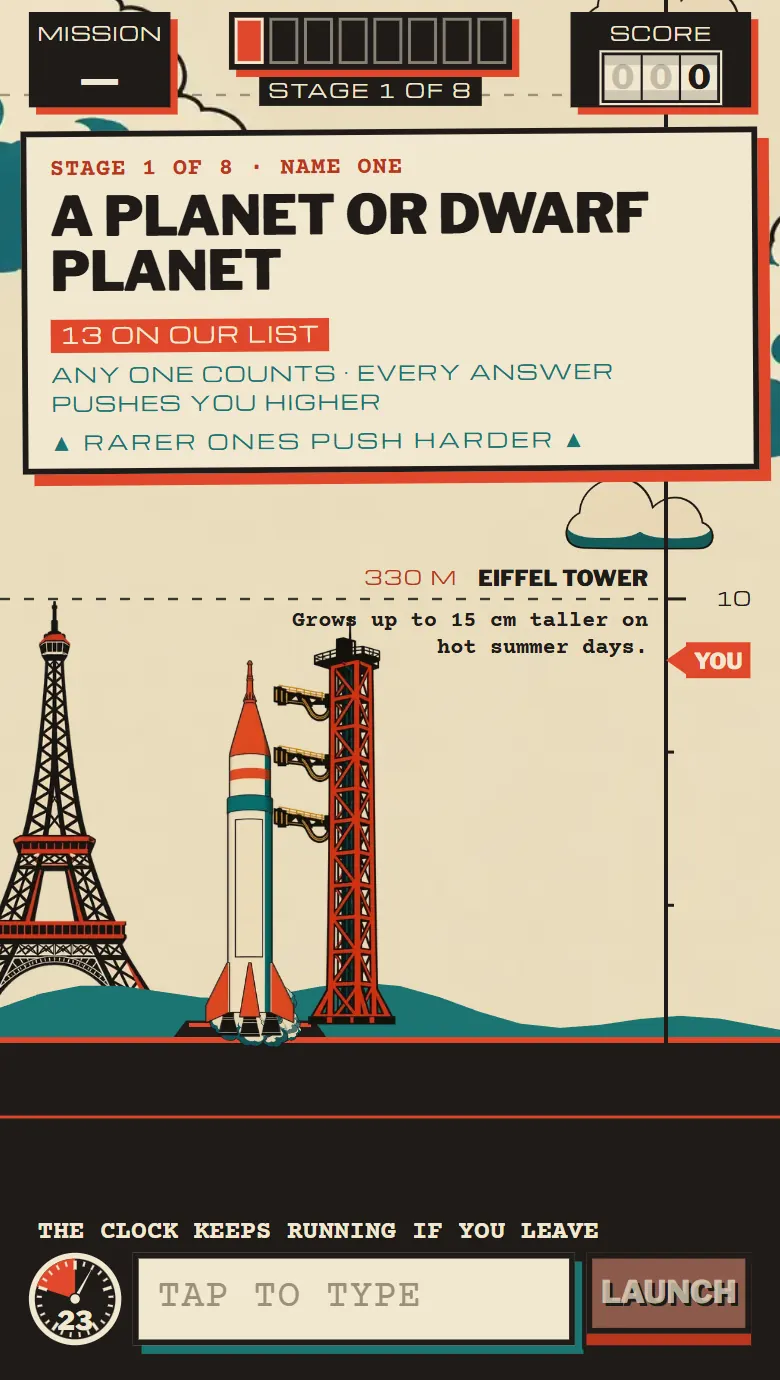
Uncommet gives everyone the same 8 prompts a day, each asking you to name one thing of a kind, with 25 seconds for each. Type one real answer and launch it. Every answer on our list scores, from 10 points for the best known to 100 for the least known, and your total across the day, up to 800, is how far your rocket gets: past the Moon, out to Mars, maybe as far as Pluto.
Where the list comes from
Every prompt has its own list of accepted answers. Almost all of them are built from two independent sources: a query of Wikidata, and the English Wikipedia list or article that names each answer. A prompt with fewer than 40 accepted answers is not a valid question and is never dealt, and we deal the bigger lists, 70 answers or more, first.
Each list is then put in order from best known to least known. The measure mixes two things: how many people read the answer's English Wikipedia article on a typical day over 60 days, which counts for 70%, and how many pages the Wikimedia wikis, Wikipedia in every language among them, have about it, which counts for 30%. Both are compared only within the same prompt, so a rare country is rare among countries, not among everything.
The points curve
An answer's points depend on its place in that order. The best-known answer scores 10. The least-known 1% of the list, at least one answer and at most five, scores the full 100. Everything between climbs a curve that is steepest at the start: moving a few places away from the obvious answers gains you more than moving a few places further along the rare end.
That has a practical meaning. You do not need the rarest answer in the world to score well. Your second or third thought, the one most people skip past, can already be worth twice the obvious one.
The prompt card tells you how many answers our list holds, so you know which kind of list you face before you type.
How your typing is matched
Nothing is suggested while you type. When you launch, an answer you named exactly goes at once, plurals included. If what you typed is close to one answer, a typo or enough of its name, the game asks "Did you mean …?" and you launch it with one more press, or keep typing. A few rules keep that fair:
- A suggestion needs at least 5 letters of the part of the name that tells it apart. Words a whole list shares, like "lake" or "battle of", and words like "the" or "saint" do not count on either side.
- From 5 letters one wrong letter is forgiven, and from 8 letters two.
- If what you typed fits more than one answer equally well, nothing is offered and the game asks you to type more. A tie is never settled in favour of the rarer answer.
- An answer that is not on the list is refused, and you can try another while the clock runs. A refusal costs you time, not points.
An answer counts only if it fits the prompt as it is worded. If a prompt asks for a city, a town is not on the list unless the prompt says city or town. If you think we turned down a right answer, the feedback form is the way to tell us; lists grow when we find real, sourced answers missing.
Today's Comet
Each prompt has one hand-picked answer from the deep end of its list, Today's Comet, worth at least 60 points and usually 85 or more, with a short checked fact about it. Name it and a comet streaks in with your burn and its fact shows on the result card. Miss it and the card tells you which answer it was once that prompt is over.
What the game rewards
From the scoring alone, a few habits pay:
- Skip your first thought. The answer that comes to everyone first is near the top of the list and worth little. Take a breath and go two or three answers deeper.
- Never time out. A sure 30-point answer beats an empty prompt by 30 points. If the clock is under ten seconds, launch the best answer you are sure of.
- Read the list size. A short list rewards each step away from the obvious; a long one needs you to go much deeper for the same points.
- Type the distinctive part. For a long name, the part that tells it apart is what gets matched. Spell the start right and finish the word.
- Speed only breaks ties. Two equal totals rank by the time spent answering, so a quick launch helps only on a tie. Never trade a better answer for a faster one.
One more thing to know: you get one mission a day, on one account and one browser. Once you have flown it, the final screen shows how today's other players answered each prompt, and your result stays put until the next mission at midnight New York time.