Quizette asks ten multiple-choice questions a day across eight subjects: science, history, geography, literature, arts, sports, food and nature. Everyone gets the same ten, with 20 seconds and four answers for each. A wrong answer key, or a question with two right answers, spoils the day for everyone who plays it, so most of the work behind Quizette is not the game. It is the questions.
Two kinds of question
On 9 November 2026 the bank held 2,696 questions: 2,148 written by hand and 548 built from open data.
Every written question names the page it was checked against, and two separate fact-check passes are recorded with it before it can be dealt. A fact that can change, like a record or a current title, also carries the date it was true on and a date it expires. If a question that could still be shown passes its expiry date, our tests fail until it is updated or taken out.
Questions about capitals, currencies, chemical elements, populations, mountain summits and the like are built from open data: World Bank figures, Wikidata, the PubChem periodic table, and public facts from NASA, the US Geological Survey and NIST, among others. Every one of them is then checked against a second, separate source, such as the CIA World Factbook or Our World in Data.
A second program checks them once more, and it shares no code with the program that made them. It reloads the raw data, reads each question the way a player would, and works out which of the four answers fits. Exactly one must, and it must be the one marked right. When the answer is a measured number, like a population, it must also be at least 10% clear of the nearest wrong answer, so no question rests on a close estimate.
Testing the testers
A checker that never finds anything might be working, or might be blind. So before we trusted ours, we fed it mistakes on purpose. In a pilot batch of 300 questions we planted errors in 5% of them, 15 questions, of three kinds a real writer could make: the right answer swapped with a wrong one, a wrong answer rewritten so that it was also true, and a short "did you know" fact changed to say something its source does not. The checker had to catch at least 95% of them.
Rules every question passes
- Four different answers, and no filler such as "none of the above", "all of the above", "both" or "neither".
- No disputed framings. Wording that invites an argument rather than an answer, like asking who "invented" or "discovered" something, is refused.
- Numbers far enough apart. When every answer is a number, each is at least 20% away from the next, so none is too close to call.
- No near repeats. A new question is turned away if it matches one already in the bank, if it has the same answer and shares half its key words with another, or if it shares 70% of its key words with any question at all.
How a day is put together
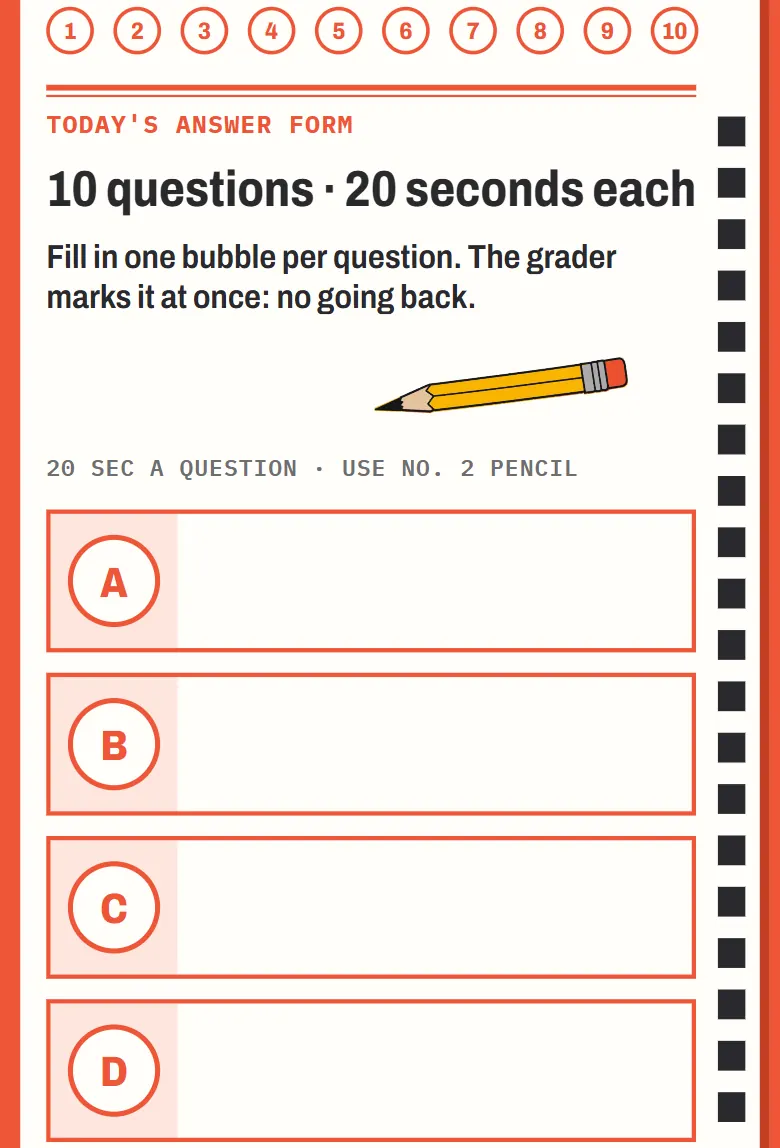
Days are dealt ahead of time into a written schedule, so a day's ten questions are settled long before anyone plays them. Every day runs from easy to hard in the same pattern of four tiers: two easy questions, three medium, three hard and two genuinely obscure.
A day covers at least seven of the eight subjects and never more than two questions from one of them, so no day becomes a theme day. At most four of the ten come from open data, and never two from the same kind of generated question.
Repeats are spaced out in three ways. The same fact stays at least 180 days apart, near repeats at least three years apart, and the same right answer at least 90 days apart. The exception is a small set of answers that are bound to come up often, the continents and the biggest countries, which may return after 14 days.
Each question is dealt only once, so while the schedule lasts no question comes back on Quizette's own day, and our tests check that none can return within 100 days, whatever happens. How a Gamefinity daily game is built explains the day itself: one New York day, one round for everyone.
Safety nets
The game carries the days ahead of it, so a new day never waits on a release. If a day were ever missing, the game would play one of 10 reserve editions kept for exactly that, the same for everyone and never practice questions, with RESERVE EDITION on its cover.
When something is wrong
A wrong or outdated question is retired. It is never dealt again, its number is never reused, and the days it was due on are refilled from the reserve, without touching today or any day already played. A question that was right but badly worded can be reworded in place, and the change is logged against every day that dealt it.
Some fixes go to the source of a mistake. In October we found that one rule in the question builder treated the euro as the currency of any country whose data mentioned it. Now only euro-area countries count, and the questions it had spoiled were retired or corrected. If you think a question is wrong, tell us through the feedback form.
Quizette in The Daily
When Quizette is dealt into The Daily, it plays ten questions from its practice pool, never a day's own edition, with the same 20 seconds each. How The Daily picks its three games explains why. Either way your score is the number you got right out of ten, and two equal scores rank by the time spent answering.