Daily IQ looks like a 1960s aptitude-test booklet. Each page is one puzzle with four to six lettered options, and you get one answer per question. Everyone gets the same ten puzzles each New York day, and on the game's own page there is no time limit. Your score is how many you got right out of ten; a stopwatch runs while each question is open, and it only matters when two players have the same score.
Every puzzle is made by the game from the day's seed and has exactly one provably correct answer. No puzzle of a day comes back within 365 days. At the end you get an IQ-style number that compares your result with today's other players. It is a game, for fun, not a clinical IQ test.
How a day is built
The ten slots have fixed levels: 1, 1, 2, 2, 3, 3, 4, 4, 5, 5. The first two are warm-ups you should get right in a few seconds. Options grow from 4 to 6 as the levels rise. Each slot draws its kind from eleven, never the same kind as the slot before and no kind more than twice, and the tenth puzzle is always a matrix. A wrong answer costs you nothing but that point: the game circles the right option, and you move on.
| Family | Kinds |
|---|---|
| Series | Number series, letter series |
| Matrices | Attribute matrix, overlay matrix |
| Odd one out | Odd number out, odd figure out, odd mirror image out |
| Space | Rotation, mirror image, paper folding |
| Relations | Analogy |
Series
For a number series, work through these in order: the differences between neighbours, then the differences of those differences, then whether each term is the last one multiplied by something, then whether each term is the sum of the ones before it, then whether two series are woven together in alternate places. The higher levels use second differences, interleaved series, alternating operations and differences that themselves grow by multiplying.
Matrices
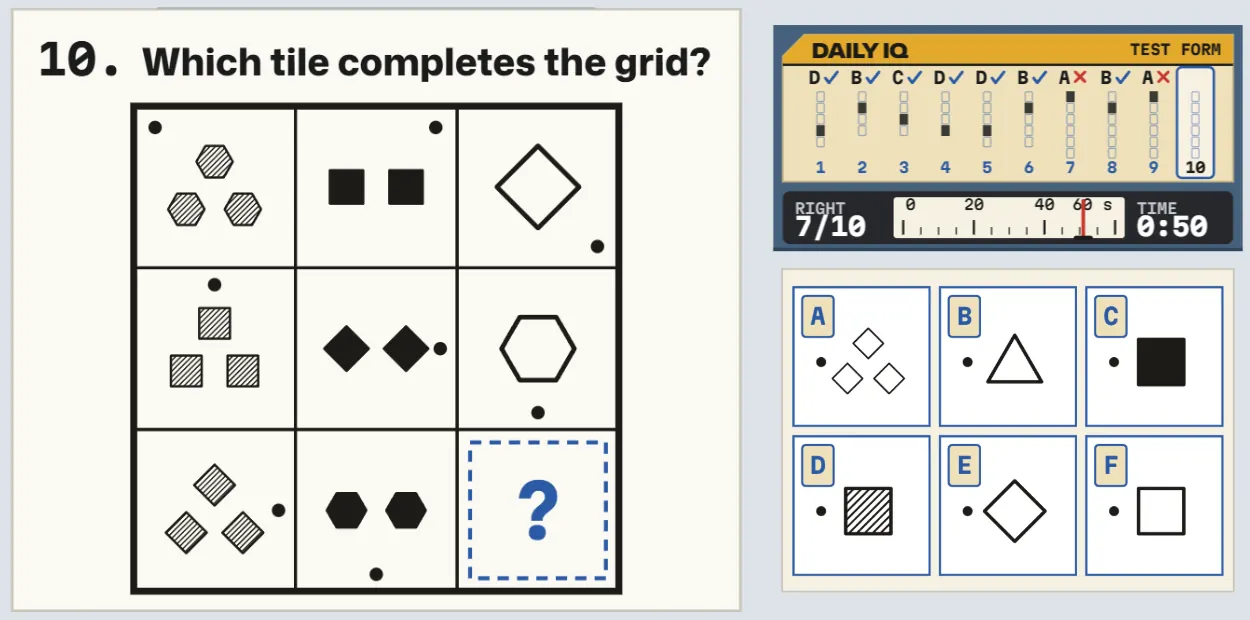
A matrix is a grid of tiles with the last one missing. In an attribute matrix, every tile has features, a shape, a number of items, a fill, a position, and each feature follows its own rule along the rows. Never try to see the whole tile at once. Take one feature, find its rule across a row, check it on another row, then move to the next feature. By level 4 a matrix can have three rules at once, and at level 5 a marker that turns round the tile as well.
An overlay matrix works differently: the first two tiles of a row, or of a column, combine into the third. They can be laid on top of each other, with the lines they share cancelling out, with only the shared lines kept, or with the second taken away from the first. Find which of those fits every complete row, then build the missing tile line by line before you look at the options.
Odd one out
With numbers, test the usual properties one at a time: even or odd, prime, square, a multiple of something, the sum of the digits. With figures, list what most of the options share and find the one that breaks it. The mirror-image version is the trickiest: all but one option are the same shape turned, and one is the shape flipped. Turning never changes which way a shape is handed; flipping always does.
Rotation, mirror images and paper folding
For rotation, pick one distinctive corner or mark on the shape and follow it as the shape turns, rather than turning the whole picture in your head. For a mirror image, find the line the mirror stands on and check that each part is the same distance from it on the other side.
Paper folding shows a square folded once or twice, with a hole punched through it, and asks what it looks like unfolded. Unfold one step at a time, in reverse order: every unfold mirrors the holes you have across that fold line, so one hole through two layers becomes two holes, and two folds make four.
Analogies
A is to B as C is to which? Write down every change from A to B: it turned a quarter, it lost a side, its fill went dark. Then apply exactly those changes to C. At level 3 there are two changes to find. From level 4 a change can be relative: if a dot moves one step round the tile from A to B, C's dot starts somewhere else and moves one step the same way. Describe each change as a movement, not as where things end up.
Habits that pay off
- Accuracy first. Your score is right answers out of ten; time only orders equal scores. A slow right answer always beats a fast wrong one.
- Rule out options. With up to six options, crossing off the ones that break even one rule often leaves only one.
- Check a rule twice. A pattern that fits one row of a matrix can be a coincidence. Make sure it fits a second row before you answer.
- Learn from the circles. When you miss, the right answer is circled for a moment. Look at why; the same kinds come back every day.
When Daily IQ is dealt into The Daily, it plays ten different puzzles with 25 seconds on each, so the habits above matter even more there.