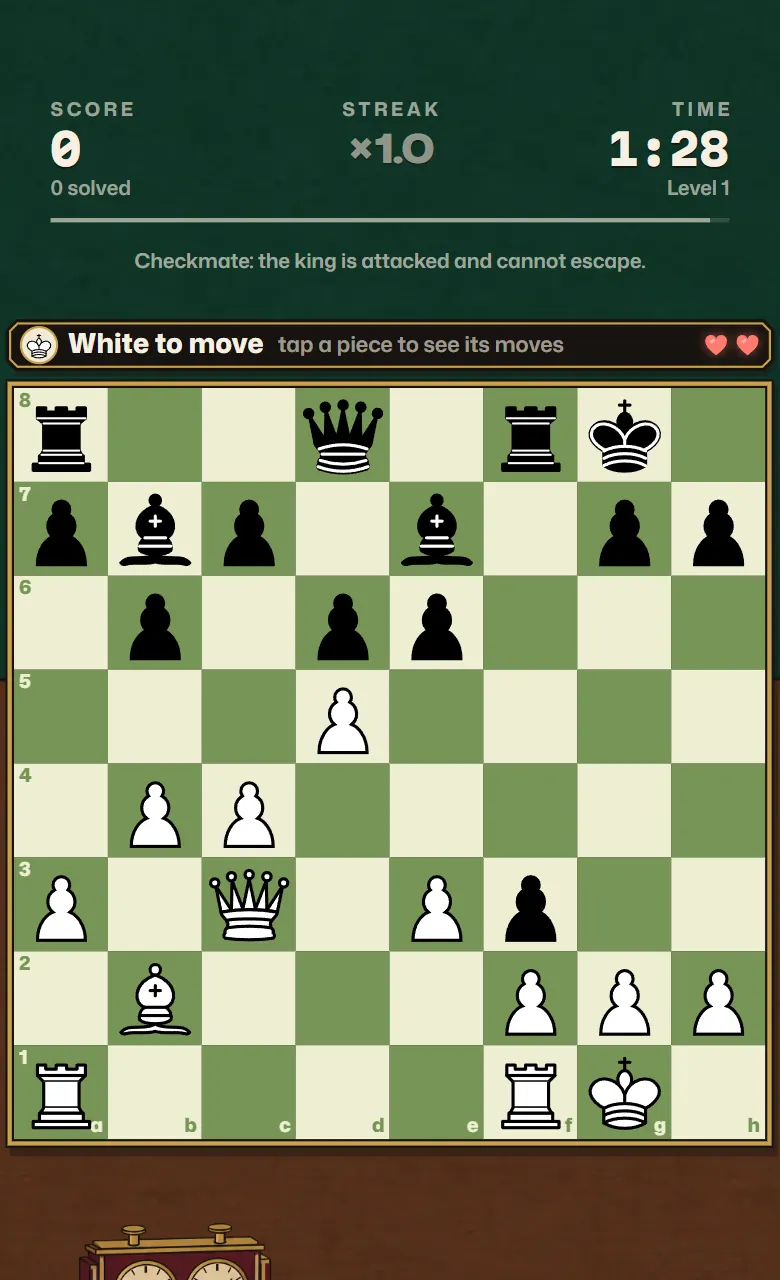
In Mate in One you get a chess position with White to move and one move that gives checkmate. Find it, and the next position appears. You have 90 seconds for as many as you can solve, and everyone plays the same puzzles in the same order each New York day.
Real games, one mate each
Every position comes from a real game, by way of the Lichess puzzle database, which Lichess publishes for anyone to use. We take the best-established puzzles first: ones played at least 300 times, rated well by the players who tried them and with a settled difficulty rating, and only where a tier needs more, ones played at least 150 times. Every position must have exactly one mating move under our own rules engine, which we check again ourselves, and positions that mate by castling, en passant or promoting to something other than a queen are left out.
Each day plays 50 puzzles from a deck of 366 days, so a puzzle never comes back within a year. Fifty is more than anyone reaches: a strong player who never misses solves about 28 in the 90 seconds, and a very fast one about 40. Every board shows White to move: puzzles where Black mates in the real game are flipped to White, so every board looks the way you learned it.
The puzzles get harder in a fixed order
| Puzzles | Tier | Lichess rating | Base points |
|---|---|---|---|
| 1 to 4 | 1 | under 700 | 100 |
| 5 to 9 | 2 | 700 to 950 | 150 |
| 10 to 15 | 3 | 950 to 1,200 | 200 |
| 16 to 22 | 4 | 1,200 to 1,500 | 300 |
| 23 on | 5 | 1,500 and up | 400 |
The first tier is kept obvious: open positions where a queen or rook gives a direct mate. From the second tier on you meet the named patterns: smothered mates, Anastasia's mate, Arabian mates, Boden's mate, mates by two bishops, discovered checks, double checks, promotions and more. Back-rank mates are limited to a tenth of each tier and never come twice in a row, so you cannot just look at the back rank.
How a solve is scored
A solve scores its tier's base points times your streak multiplier, plus a speed bonus. The multiplier starts at ×1.0 and grows by 0.2 for each puzzle solved in a row, up to ×3.0 after a streak of 10. The speed bonus is 50 points for an instant solve and drops to 0 after 10 seconds. One puzzle is worth at most 1,250.
A wrong move costs a lot more than it looks. It takes 5 seconds off your clock, sets your streak back to zero and leaves the position on the board. A second wrong move on the same puzzle shows you the mate, scores nothing and moves on. After 12 seconds on one puzzle a hint rings the piece that mates, and that puzzle's points are halved; the hint does not touch your streak.
What that means for how you play
- Accuracy beats speed. The speed bonus is at most 50 points; the multiplier can triple a puzzle's value. Taking a second longer to be sure is almost always worth it.
- Check every check. Every mate is a check, so list the checks first. The harder tiers deliberately hold checking moves that do not mate, about four per position on average in tier 5, so the first check you see is often a decoy.
- Count the king's escape squares. Before you move, look at where the king could go. A mate leaves it no square: covered, blocked by its own pieces or off the board.
- Wait for the hint rather than guess. If you are stuck between two moves, a wrong guess costs 5 seconds and your streak. The hint at 12 seconds halves this one puzzle and keeps the streak alive.
- Learn the patterns. Smothered mates hide behind the king's own pieces, Anastasia's and Arabian mates use a knight with a rook, and Boden's mate needs two bishops on crossing diagonals. Once you know the shapes, you see them in a second.
When the clock runs out, the puzzle still on the board shows its mate, and the end of the run shows the mate of every puzzle you were dealt, so every miss teaches you a pattern for tomorrow. Two players with the same score rank by who reached it sooner.